Main contractor
A board-marked elevation cast in four lifts
Sawn board grain on an in-situ wall, four lifts from one liner, and a release agent that had to be tested before anything was poured.
Read the jobExample project
Forty millimetres of relief with tight returns, running as a production item in a precast yard. Polyurethane would not have lasted the run, and the air had to be given somewhere to go.
The brief
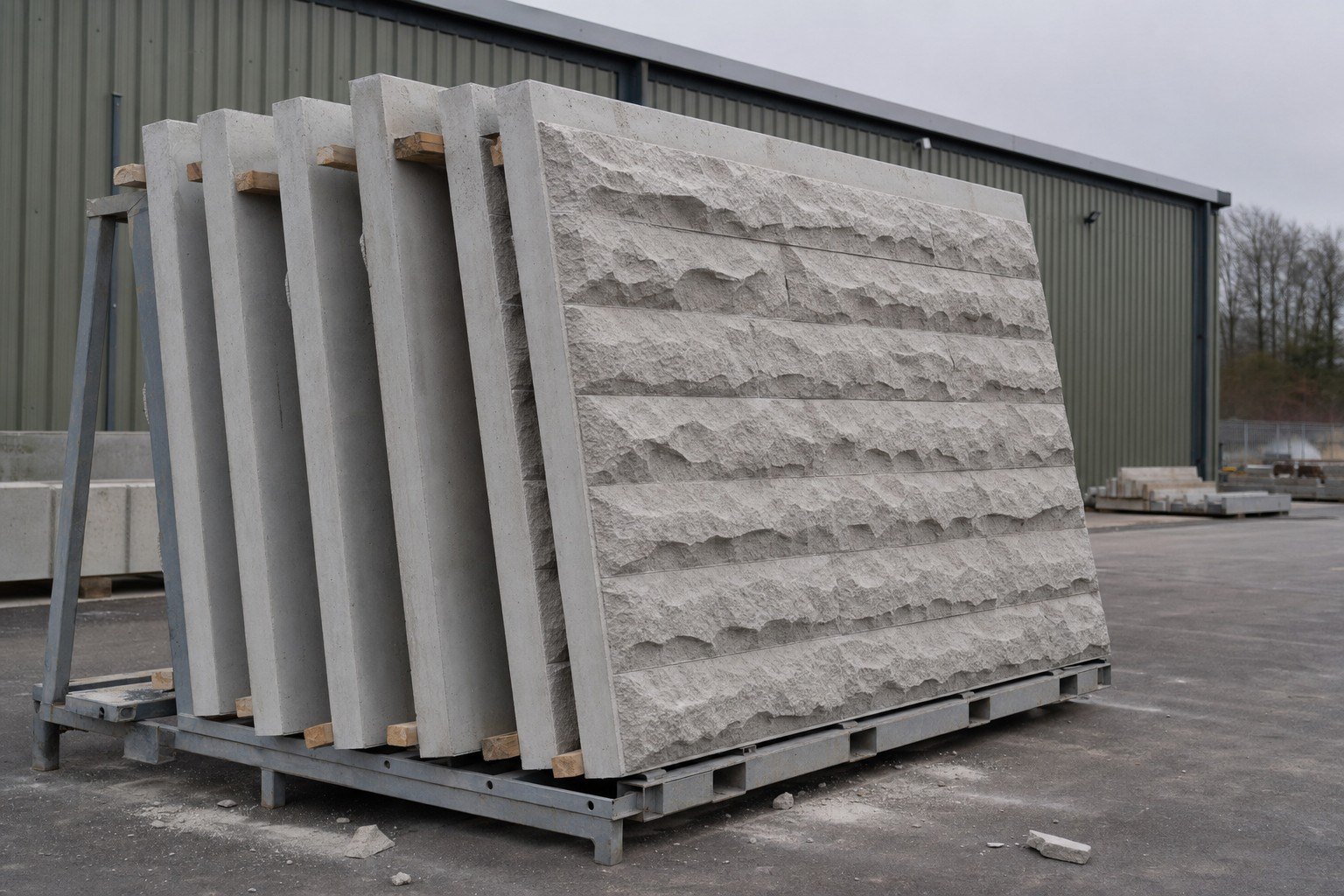
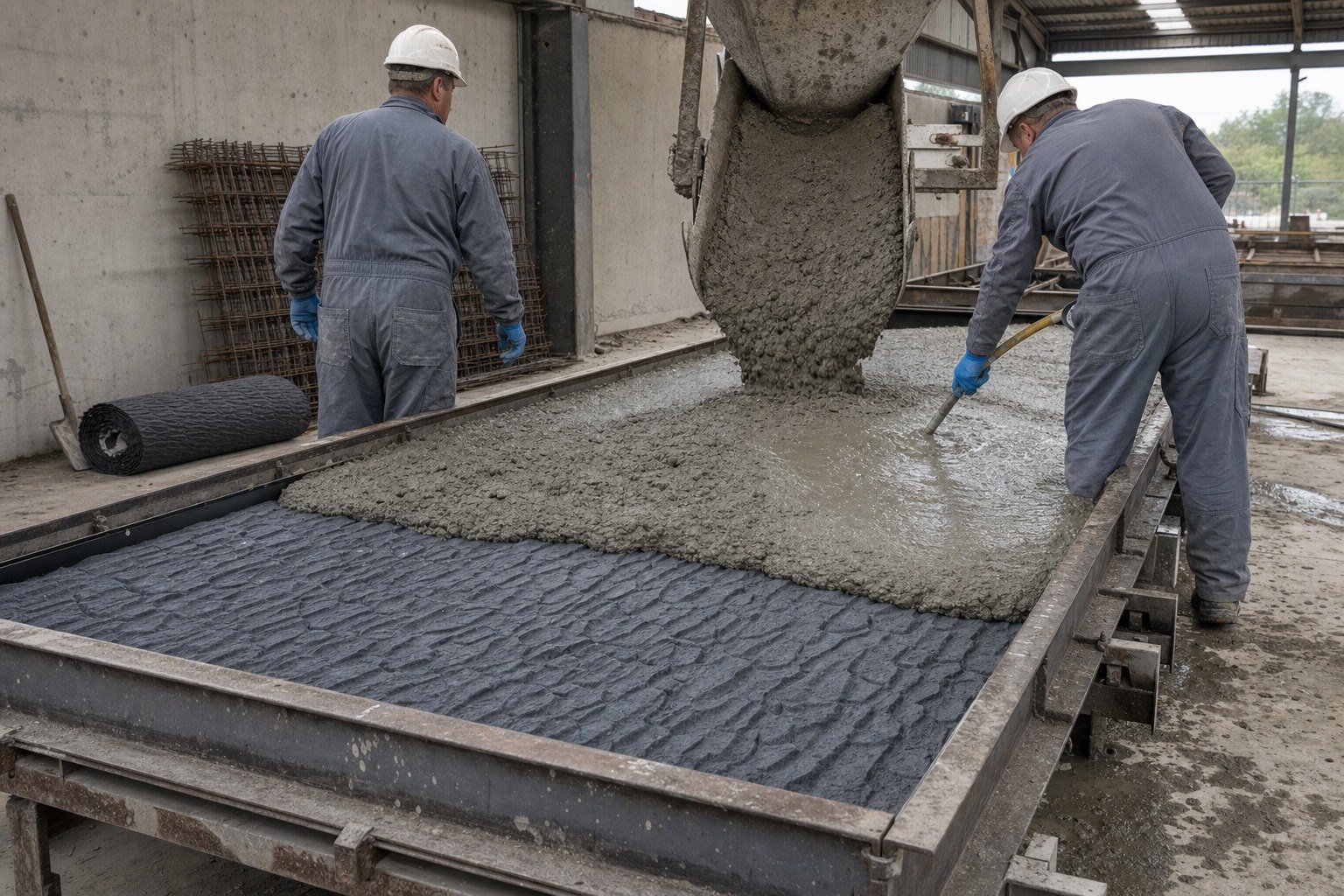
A precast manufacturer had won a facade package with a repeating feature panel: deep modelled relief, around forty millimetres from the high point to the ground, with returns close to vertical. The panels were to be wet cast in a bed under a covered yard as a standing production item.
They already knew what they wanted made. What they asked us to settle was the face material and the backing, because they had been burned before by tooling that was fine for a sample panel and finished long before the order was.
The difficulty
At forty millimetres with near-vertical returns, every strike pulls the face material into tension around the relief and then asks it to recover its shape. Polyurethane liners are normally quoted in tens of pours and at this depth they are at the pessimistic end of that, because the material takes a set and the relief slowly loses its edge. Silicone is normally quoted in hundreds. On a one-off panel that difference is an argument about price. On a production item it decides the job.
The second difficulty was air. A deep pocket with tight returns is an air trap: the pocket fills last, the air above it has nowhere to go, and it prints as a blowhole cluster in the most visible part of the relief. The yard's instinct was to vibrate harder, which on a wet cast face brings its own problems with segregation and grout lines.
Third, the panel was big and silicone is a face material. An unbacked liner of that area moves under the head of concrete, and a face that moves gives a panel that is not the size on the drawing.
How we did it
We specified a silicone face because the run was in the hundreds. The comparison we put in writing was the honest one: polyurethane costs less to buy and is a reasonable choice at tens of pours, and it was the wrong choice here. The same reasoning is set out on the mould materials page.
Two of the returns were drawn dead vertical. We proposed a small draft on them, checked it against the elevation with the designer, and it was not visible at viewing distance. That change alone took most of the stripping load off the face and it made every pour after it easier.
The pockets were oriented and vented so the last air out of the deepest point has a path to the top of the pour, and the yard's placing sequence was changed to fill the relief first rather than flood the bed. That is a cheaper fix than more energy at the poker, and it does not risk the face.
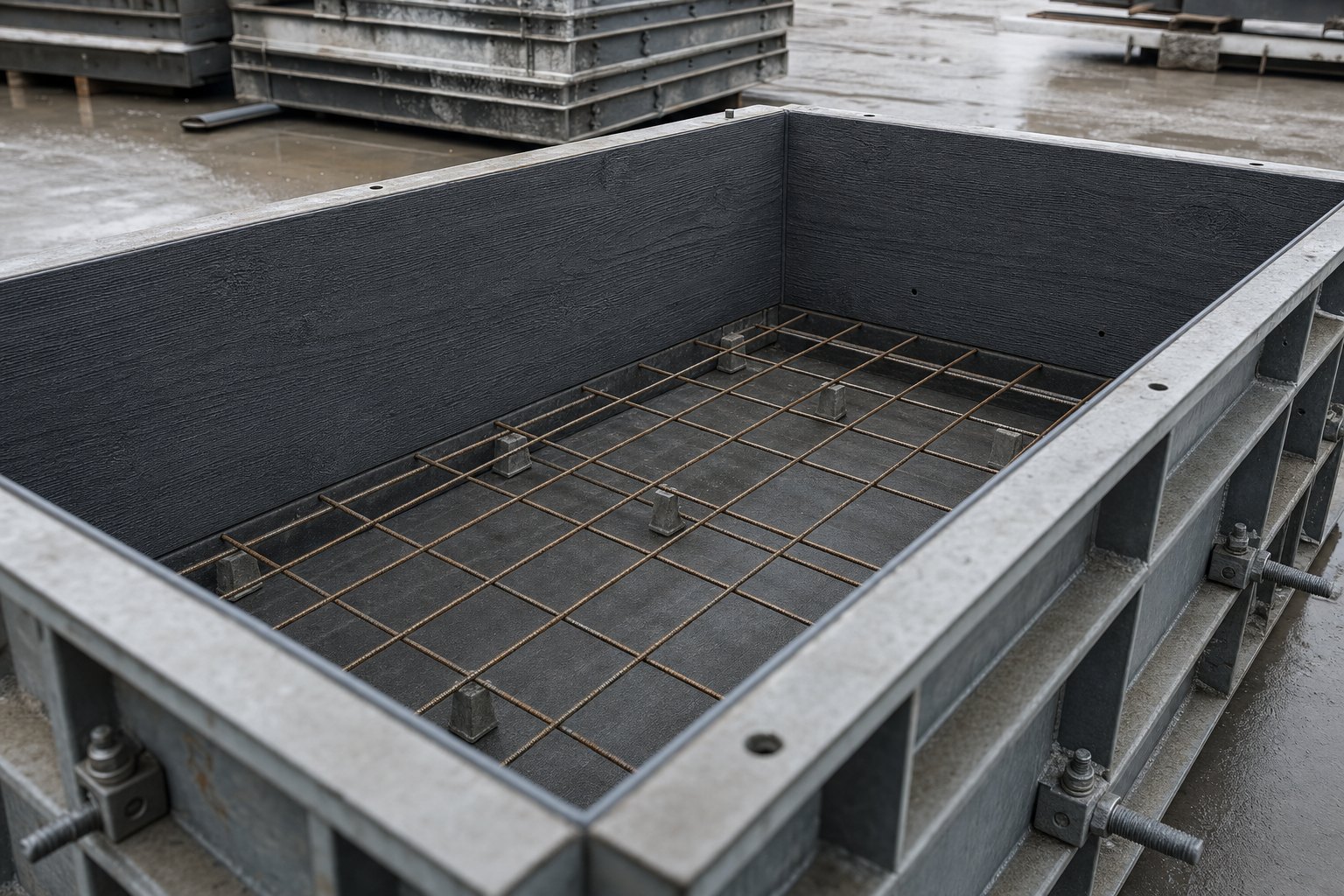
The face sits on a rigid backing frame with ribbing and handling points, made alongside the liner rather than improvised in the yard. The frame is what holds the panel to size and it is what lets the crew move the tooling without levering on the face.
The numbers
Same indicative published rate, same division.
The face was 4.5 square metres. At an indicative £350 per square metre that is £1,575. Cleaned properly and stored flat, casting around a hundred units, it puts 450 square metres of finished face on the building. That is £3.50 per square metre of face, which is £350 divided by a hundred, and it matches the figure the same published source gives at that level of reuse.
At three pounds fifty a square metre the tooling has stopped driving the decision. What drives it then is whether pour eighty looks like pour three, which is a question about the release agent, the strike sequence and whether anyone has trimmed or drilled the face. A liner rated for a hundred pours can be finished in twenty by a bad strike.
All of the arithmetic below runs at the same indicative rate of £350 per square metre of liner, from published figures from PERI UK and RECKLI. It is a market figure carried here so the division can be checked, and the liner calculator will run it on your own rate instead.
Scroll sideways to see the whole diagram.
Every money figure on this page is indicative. It is taken either from the illustrative two year duty cycle used across all five TCI sites or from published third-party pricing, and it is shown so the arithmetic can be checked. None of it is a quotation, and all of it must be replaced with TCI figures before launch.
Where it got to
The services and the reference material this project drew on.
More jobs
Main contractor
Sawn board grain on an in-situ wall, four lifts from one liner, and a release agent that had to be tested before anything was poured.
Read the jobHousebuilder
Semi-dry units struck green, six profiles in one family, and arrises that had to survive being handled at their weakest.
Read the jobFacade specialist
A pattern that had to run across the joints, from liners that had to match each other and keep matching as they aged.
Read the jobSimilar job?
Tell us the relief depth and how many units are in the package. Those two numbers usually decide the face material on their own.