Bidford-on-Avon, Warwickshire. Mon to Fri.01789 224228sales@tci-construction.com

Solutions

Formliners, precast
moulds and GRC
tooling.

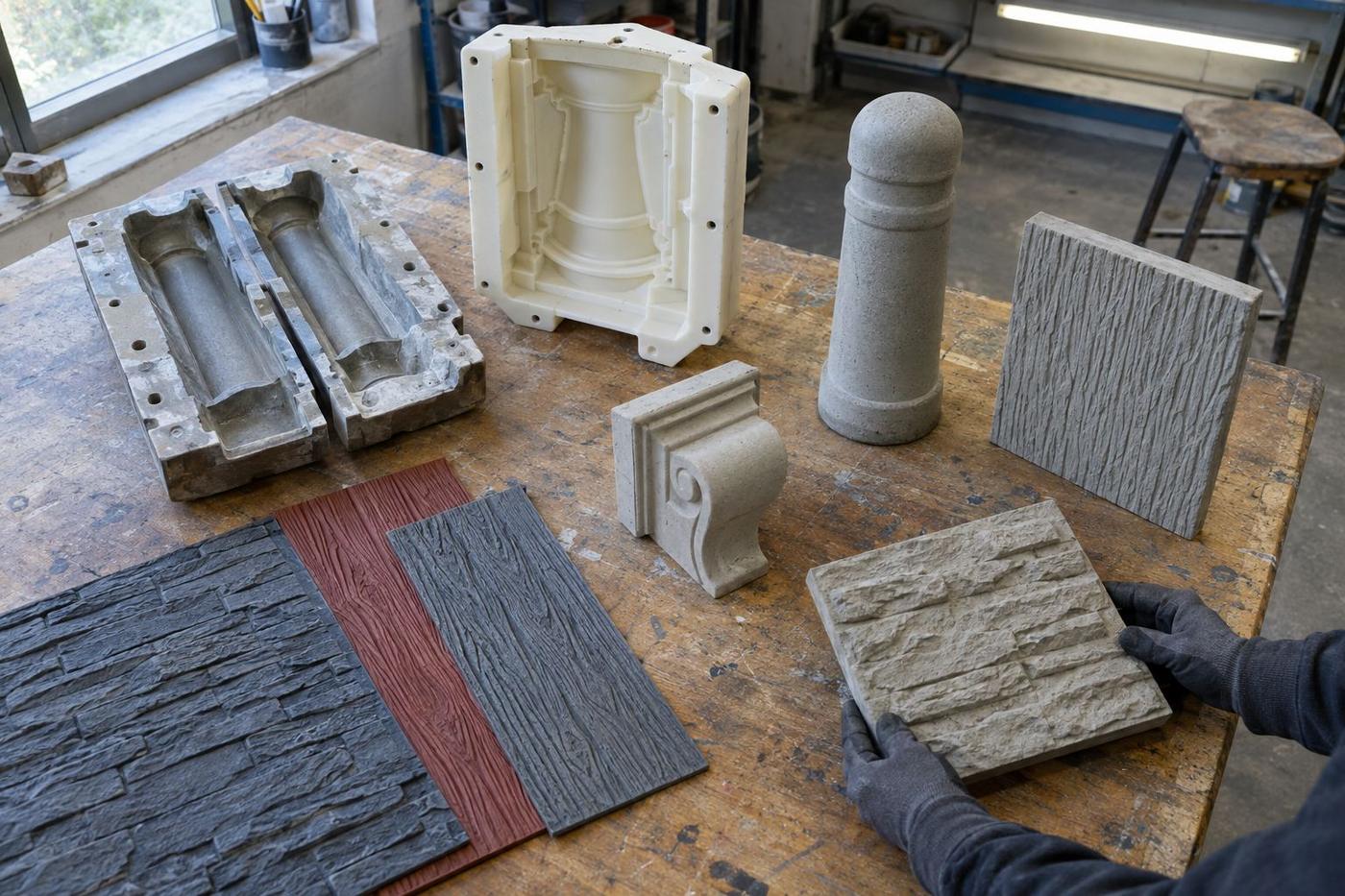
Silicone formliners, precast concrete moulds, GRC moulds and architectural restoration moulds, plus the patterns and backing frames that make them work. The specification is set by the cast unit and the yard it will live in.

Core offer

Five things customers come to us for.

01

Silicone formliners

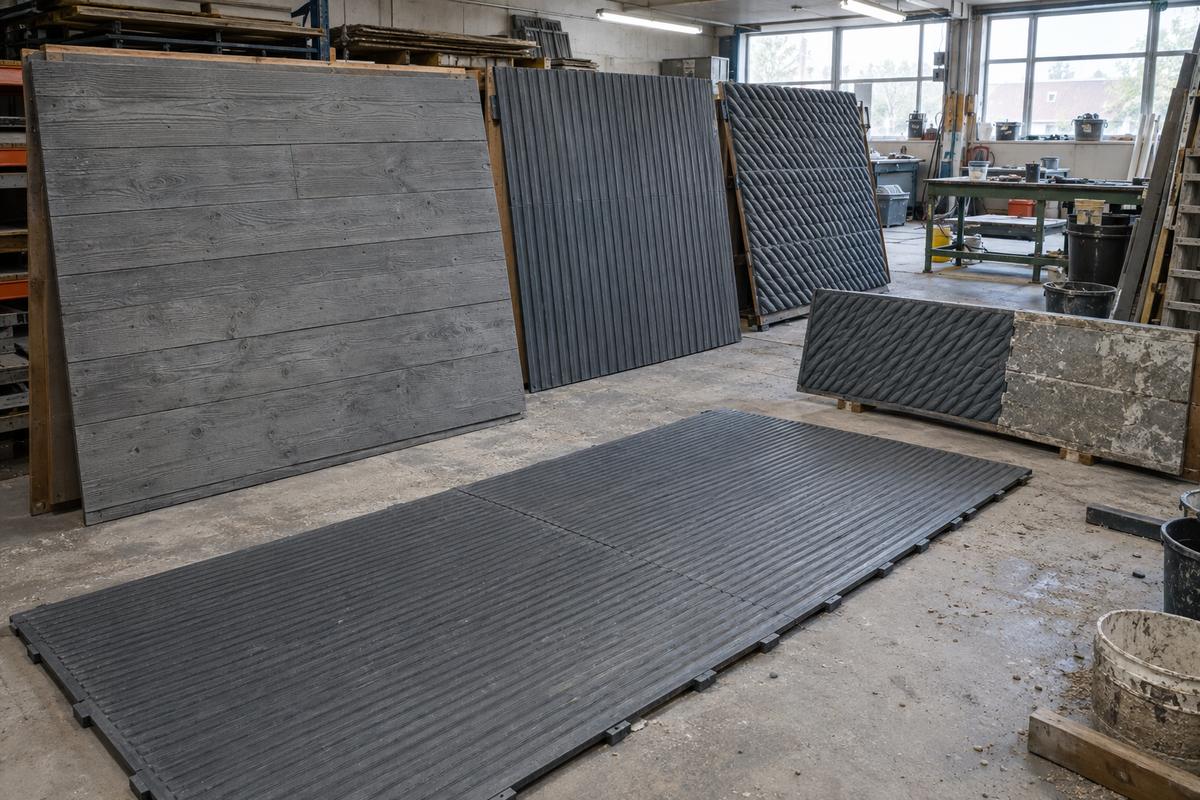
Flexible liners that cast a texture or a relief into the concrete face. Split stone, riven slate, board-marked timber, brick, ashlar, custom relief, artwork. Single sheets or matched sets for a whole elevation.

02

Precast concrete moulds

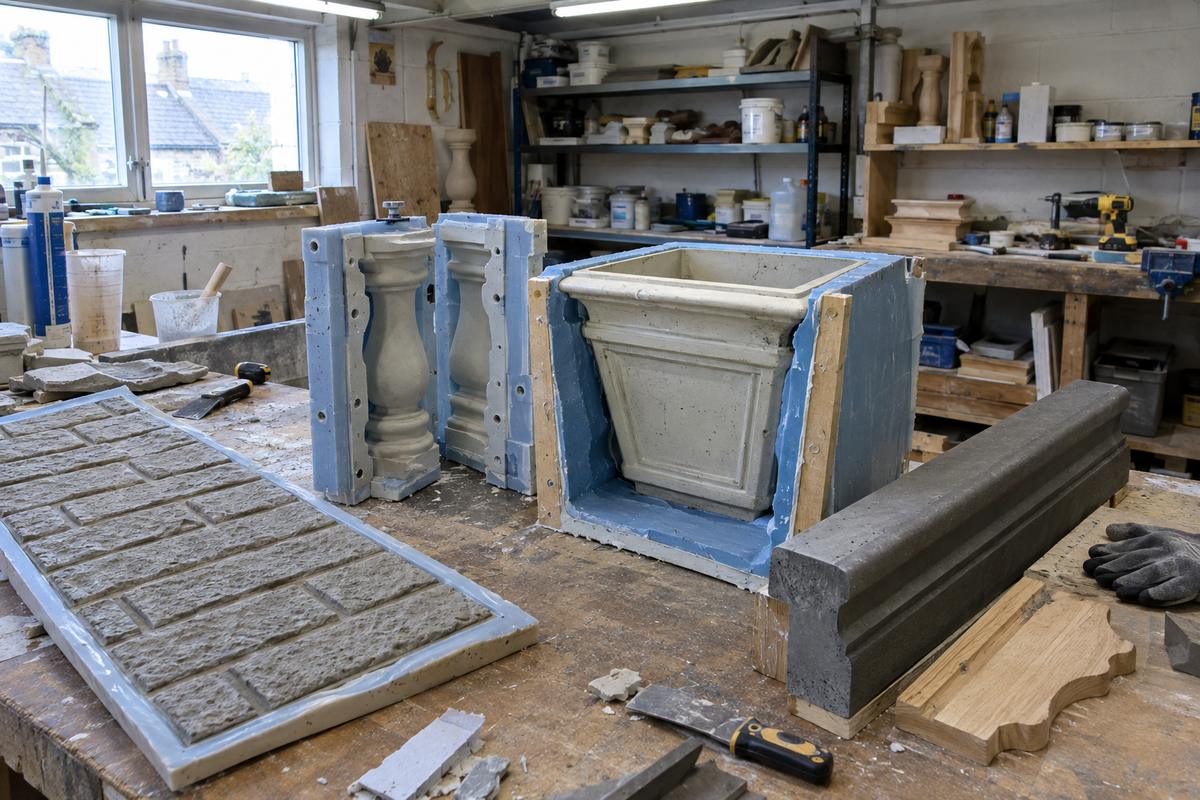
Moulds for cladding panels, copings, cills, lintels, bollards, planters, drainage furniture and bespoke architectural units, with the backing structure designed at the same time as the face.

03

GRC moulds

Tooling for thin-shell glassfibre-reinforced concrete: facade units, cornices, columns, canopies. Built around hand-lay or spray-up and a rigid frame.

04

Cast stone, plaster, resin

Tooling for cast stone units, fibrous plaster cornice runs, ceiling roses, corbels plus resin architectural components, where the detail expectation is much higher.

05

Architectural restoration moulds

Taking a mould directly off a weathered original so the replacement matches, in situ where the carving can stay on the building.

The full range

Everything we make for concrete and architectural casting.

The five headings above are what people ring about. This is the whole list, with the reuse expectation against each one, because that is what decides whether a liner is a consumable or a piece of capital equipment.

What we make, and how many pours each is specified for

What we make, and how many pours each is specified for
What it isWhere it is usedReuse expectation
Single-use formlinersA one-off feature elevation, or a single bay where the liner is consumed by the jobOne pour, and priced on that basis
Multi-use formlinersRepeated bays and lifts across a frame, or a liner that moves up a buildingQuoted against your pour count
Pattern and texture linersSplit stone, riven slate, board marking, brickwork and ashlar across an elevationMatched sets poured off one pattern
Feature and relief panelsLettering, logos, artwork and bespoke relief cast into the face rather than appliedVacuum cast face where the detail is fine
Cast stone and precast mouldsHeads, cills, quoins, copings, cladding panels, balustrade and bandingBacking engineered with the face
Bespoke profiles and corniceFibrous plaster cornice runs, ceiling roses, corbels and enrichmentsTaken from a profile, a drawing or a fragment
Rubber moulds for repeat unitsKerb, paving, bollard and drainage units in a yard running the same shape dailySpecified for abrasion ahead of fine detail
One-off restoration mouldsMatching an existing profile or carving, moulded in situ where it can stay in placeOne or two pulls, with no amortisation

Reuse expectation is what the tooling is specified and quoted for, agreed in writing with your order. It is not a guaranteed cast count, because the mix, the release regime and how the panel is struck decide most of it.

Elastomeric liners are normally quoted in hundreds of pours and polyurethane in tens. Custom Rock puts standard urethane liners at 20 to 100 or more uses, and Betonblock lists panel prices of £145 to £270. Those are indicative market figures for context, not our rates.

Site-cast or precast works

The same liner, two completely different sums.

Where the concrete is placed changes the economics more than the texture does, so it is the first thing we ask.

01

Site-cast, in formwork on the building

The liner is fixed into the shutter and travels with it, so it takes stripping damage, site handling and whatever release agent the gang already has in the van. Pour counts are low and usually known exactly from the pour schedule. Specify for survival on site rather than for a long life it will never see.

02

Precast works, in a bed under a roof

The liner lives in a controlled bed, gets cleaned properly and can run for a long time, so the cost per square metre of finished face becomes very small. That is where a harder face, a proper backing and written storage guidance earn their money, and where a hundred pours from one liner is a realistic thing to specify.

Moulding routes

What we mould, and how each route behaves on concrete.

Everything here is moulded, and hand-made and cast moulds carry most construction work.

Red silicone mould standing beside the carved stone capital it was taken from, brushes to hand
Hand-made

Hand-made moulds

Brush-applied silicone built up in layers, straight onto a pattern or onto an original carving on the building. It goes where a pour cannot: vertical faces, in-situ work, deep undercut.

Wet concrete placed from a skip chute into a steel casting bed lined with riven-textured formliner
Cast

Cast moulds and cast parts

Open-pour and block moulds in silicone or polyurethane, poured under gravity onto a pattern plate. The route behind most formliners and precast unit moulds.

Machined steel mould halves laid on drawings beside moulded parts, calipers and a micrometer
Vacuum cast

Vacuum casting

The same pour, degassed in a vacuum chamber first. Worth it where a single trapped bubble would print into every panel: fine ashlar, lettering, sharp arris, a logo cast into a spandrel face.

Bench-scale compression press with an amber silicone gasket in the open steel tool
Pressed

Compression and injection moulding

Solid silicone and rubber pressed under heat in a steel tool, and liquid silicone rubber injected for repeat volume, where the moulded component itself is the product.

How each moulding route works on concrete

Steel formwork lined with deep board-marked elastomeric liner, reinforcement on spacers above, before the pour

Formliners

What is a concrete formliner, and when is silicone worth it?

A formliner is a face material that casts a texture or a relief into the panel instead of applying it afterwards. It has to release cleanly, hold its relief through repetition, and flex enough to come off an undercut while staying stiff enough not to distort under the pour. Those last two pull against each other, so we ask about the mix, the table and the strike sequence before recommending a hardness.

Deep relief is where silicone earns its cost, because a liner that flexes off the set panel will release a split-stone face or a carved relief that a GRP mould could not clear at all.

  • Split stone, riven slate, board-marked timber, brickwork, ashlar faces
  • Custom relief, lettering, logos, architect-supplied artwork, from a sketch or a 3D file
  • Matched liner sets so a whole elevation reads consistently across every panel
  • Plywood, steel or resin-and-glassfibre backing, designed with the face rather than after it
  • Patch-tested against your mix and your release agent before the first production pour

What you are actually buying

A liner is a build-up, and the textured face is one layer of it.

Specifications often describe the texture and say nothing about what sits behind it. The layers behind the face are what decide if the texture survives the pour.

Scroll sideways to see the whole diagram.

Two of these layers cause most of the problems we are asked to diagnose. The release agent is chosen on site, long after the liner is specified, and the backing is the line item people try to remove from a quotation. Take the backing out and the face bows under the pour, so the texture is correct and the panel is not.
Cast concrete units with moulded pockets and a lifting eye beside a grey silicone mould

Precast

Precast concrete tooling for units that have to repeat.

Precast work is a repeatability problem more than a detail problem. The first unit is rarely the difficulty. Unit forty matching unit one, after the mould has been vibrated, steam cured, struck, hosed down and stacked outside, is the difficulty.

So the specification tilts harder and stiffer than decorative work. Around 40 to 60 Shore A for flat repeat panels, where dimensional stability across the run beats flexibility, with the rigidity carried by a frame rather than by the rubber. Where a unit has genuine undercut we use a softer face locally and keep the harder material everywhere else.

  • Cladding and spandrel panels, copings, cills, lintels, string courses
  • Bollards, planters, benches, drainage furniture, hard-landscaping units
  • Bespoke architectural units taken from an architect's detail or a site survey
  • Retained patterns, so a replacement mould is genuinely a replacement
Glassfibre-reinforced concrete being hand-laid into a curved GRC mould with a roller

GRC

Why do GRC moulds need a rigid frame behind the face?

Glassfibre-reinforced concrete is worked into the mould by hand or by spray, layer by layer, with a roller compacting it against the face. That is a very different loading pattern from a wet pour. It is intermittent, local, and applied with real force. A silicone face with nothing behind it moves under the roller and the shell reads wavy.

So we treat a GRC mould as two engineered parts. The face gives release, texture and undercut clearance. The rigid backing gives the geometry, and curved surfaces need more ribbing than people expect.

  • Facade and rainscreen units, cornices, columns, capitals, canopies
  • Faces engineered for hand-lay and spray-up rather than for a wet pour
  • Steel, plywood, resin-glassfibre backing frames made in the same building
  • Demoulding sequence agreed with your team before the mould is committed
Carved stone capital in a bench clamp beside the red silicone mould lifted from it

Heritage and restoration

Can you take a mould off a building without removing the stone?

Usually, yes, and that is how most of our restoration work goes. The constraint is simple: the original must not be damaged, and ideally should never leave the building. Where access allows we mould in situ, dammed then supported, and take the mould off in one piece so the carving stays where the mason put it.

Weathered stone is friable and often carries old consolidants, paint or release residue, any of which can inhibit a platinum-cure silicone, so a patch test on an inconspicuous area comes first. Softer material, indicatively around 20 to 30 Shore A, lets the mould flex out of undercut no rigid tool would clear.

  • In-situ moulding of corbels, capitals, string courses, tracery, carved relief
  • Bench moulding where a unit can safely be removed and returned
  • 3D scanning and digital rebuild where detail has been lost to weathering
  • Replacement units cast in cast stone, GRC, plaster or resin to suit the elevation

Cast stone plus plaster and resin moulds

The kinder materials, with the harder detail expectation.

Plaster and resin do not punish a mould the way concrete does, but the piece is usually viewed from two feet away rather than from the pavement, so the surface has nowhere to hide.

Precast panels with a deep riven stone face stacked on edge in a galvanised yard rack
Cast stone

Cast stone and reconstituted units

Semi-dry and wet-cast tooling for cast stone heads, cills, quoins, balustrade and banding, where the unit sits next to natural stone.

Concrete being placed and vibrated into a formliner-lined casting bed in a precast yard
Fibrous plaster

Cornice runs, ceiling roses, corbels

Moulds for fibrous plaster: cornice and moulding runs, ceiling roses, corbels, enrichments. Taken from an existing profile, a drawing or a surviving fragment.

Grey moulded silicone rings, bushes and a fluted component laid out on a plain surface
Resin

Resin architectural components

Tooling for resin components and decorative mouldings, including lightweight alternatives for a restored elevation.

Engineering support

The parts of the job that are not the mould.

A mould that is technically correct and impossible to run in a yard is still a failure. These sit inside the quoted price rather than as extras.

Design for demoulding

Relief depth, draft, joint lines, air escape and pull direction, all reviewed against your bed, your table and your strike sequence before tooling is committed.

Survey, scanning plus reverse engineering

3D scanning and geometry rebuild from a weathered original, a fragment or a legacy mould, so a discontinued profile can be brought back into production.

Backing, frames, fixtures

Plywood, steel, resin-glassfibre backing designed and made alongside the face, plus ribbing, handling points and jigs. A liner with no structure behind it will move.

Cost per square metre of finished face

Divide the liner by the area it casts, then by the pours.

A liner price on its own tells you very little. The figure that belongs next to a cladding rate is cost per square metre of finished concrete face, per pour, and it is a simple division you can do yourself below.

On published figures from PERI UK and RECKLI, an architectural liner at around £350 per square metre works out at about £35 per square metre of finished face at ten reuses and about £3.50 at a hundred. That is the whole commercial argument for elastomeric tooling, and it is also why a one-off feature elevation is a different conversation: at a single pour the same liner is the full £350 per square metre of face, with nothing to spread it over. Pull the pours slider down to one and the calculator will show you that.

These set the sliders to a shape of job we see often. Move them to match yours.

The area of one liner only, rather than the whole elevation.

Set this to your quoted rate. The default is a published market figure for an architectural liner, used here as an example only.

A well looked after polyurethane or silicone liner is normally quoted in tens of pours, and elastomeric liners in hundreds.

per m² of finished concrete face, per pour
  • Liner cost
  • Cost of one pour
  • Total face area produced

Liner only. Formwork, release agent, labour, cranage and the concrete itself sit on top. Reuse counts assume the liner is cleaned and stored properly between pours.

Figures are indicative market rates carried here so the arithmetic works. They are no substitute for a TCI quotation, and your own rate goes in the first field.

What destroys the pours you paid for

Three habits, and all of them are avoidable.

  • The wrong release agent. A petroleum-based or reactive agent swells or softens a silicone face, and it can do it on the first pour.
  • Mechanical damage while stripping. Crowbars against the liner, panels dropped face down, a liner peeled cold and fast off deep relief.
  • Cutting or drilling on the face. Trimming a liner in place or cleaning it with a scraper leaves marks that print into every panel afterwards.

Cost per use

What a mould really costs, per piece it makes.

A mould price on its own tells you almost nothing. The number that decides whether a job works is what the tooling costs you per finished piece, and on the work we do most that lands at about £0.0016 per use per cavity. That is a sixth of a penny. Here is the arithmetic in full, and a calculator so you can put your own figures in. The arithmetic below is the same division applied to a multi-cavity mould rather than to a liner, because some construction customers buy component tooling from us as well. Read it as cost per cavity per use. If you are buying a formliner, the square-metre figures above are the ones that matter.

Scroll sideways to see the whole diagram.

The same GBP 95.00 looked at four ways. A mould price only means something once you divide it by the cavities and then by the uses. The last bar is a sixth of a penny. That is the number to put next to your annual volume.

Scroll sideways to see the whole diagram.

Where 2,000 uses comes from. It is not a marketing number, it is a fairly relaxed two year duty cycle you can check in your head. If you run harder than this, tell us and we will spec the mould for it.

Scroll sideways to see the whole diagram.

Tooling cost per pull against cumulative uses, for the GBP 95.00 mould. Both axes are logarithmic, which is what turns the curve into a straight line: every doubling of uses halves the tooling cost per pull, and there is no point at which that stops. It is also why a tool quotation means very little until you read it next to an annual volume.

Scroll sideways to see the whole diagram.

The rate holds at programme scale. A set of 40 moulds at £38 each is a very different invoice to one mould at £95, and it lands on the same £0.0016. That is not a coincidence, it is what happens when cavity count and tool price move together.

Work it out

Put your own numbers in.

Set the mould price, the cavity count, the size of the order and how hard you will run it. The figures update as you move the sliders. Tooling only, and the mould prices are yours to set rather than a quotation from us.

These set the sliders to a shape of job we see often. Move them to match yours.

What you pay for a single mould or tool.

How many finished pieces come out of one pull.

One for a single tool. More for a production set.

2000 is the figure our two year cover is written against. It is about four pulls a day, five days a week, for two years.

of tooling cost per use, per cavity
  • Cost per cavity
  • Cost per pull of the whole mould
  • Cavities working at once
  • Pieces over the life of the order
  • Tooling per 1,000 pieces
  • Total tooling spend

Tooling only. It does not include the material you cast, labour, packing or carriage. Mould prices here are sliders you set. They are not a quotation from us.

Prefer us to do this on your actual part? Send a drawing or a photograph and an annual volume and we will come back with the tool cost, the cavity count we would recommend and the per piece figure. Ask for a costing.

Two year cover

Two years, or 2,000 uses. Defects and normal wear.

Most mould suppliers cover manufacturing defects and stop there, which is fine until a tool wears out in eight months and nobody will say why. We cover both: the things we got wrong, and the mould simply not lasting as long as we said it would.

01

Manufacturing defects

Voids, tears at the parting line, cure faults, wrong dimensions against the drawing we signed off, a cavity that was never right. Replaced or rebuilt at our cost for the full two years. No apportionment, no argument.

02

Normal wear, early

If a mould stops holding the part to drawing before 2,000 pulls, under the conditions we agreed at order, we credit the life you did not get. Half the life used means half the value back against a replacement.

03

Carriage on us

If we ask for the mould back to look at it, we pay to get it here. You should not be out of pocket to prove our tool has a problem.

04

Written into the quotation

The duty cycle, the casting material, the temperature range and the release regime go on the quotation. That is what the cover is measured against, so there is nothing to argue about later.

Scroll sideways to see the whole diagram.

What actually happens when a mould goes wrong. We have deliberately kept the first step to photographs, because most faults are obvious in a photograph and shipping a mould back and forth wastes a week.

What is covered and what is not

What is covered and what is not
CoveredNot covered
Defect in manufactureYes, full two years, replaced or rebuiltNo exclusions apply
Dimensional error against the signed drawingYes, full two yearsNo exclusions apply
Wear before 2,000 uses in agreed conditionsYes, pro rata credit on the life not usedNo exclusions apply
Cutting, trimming or scraping on the mould faceNoNot covered. Mechanical damage is not wear.
Use above the rated temperatureNoNot covered. The rating is on the quotation.
Caustic or solvent washing outside the stated regimeNoNot covered. It attacks the surface finish.
Casting a material we were not told aboutNoNot covered. Some resins and sulphur bearing clays inhibit cure.
A change of part or process after the tool was madeNoNot covered, but tell us and we will quote a modification.

Two years runs from the despatch date. Cover is on the mould, not on what you cast in it. Where a mould is one of a set, cover applies to each mould individually rather than to the set as a whole.

This summary sits alongside our conditions of sale, which are issued with every quotation. Ask us to put the duty cycle in writing on your quotation and it becomes what the cover is measured against.

Job size

One mould, or a rolling annual programme.

We are set up for long production programmes with a repeat schedule, and we quote them properly: tool cost, unit cost and what happens when the tool wears. That is the work that keeps a workshop like ours stable.

01

A single mould

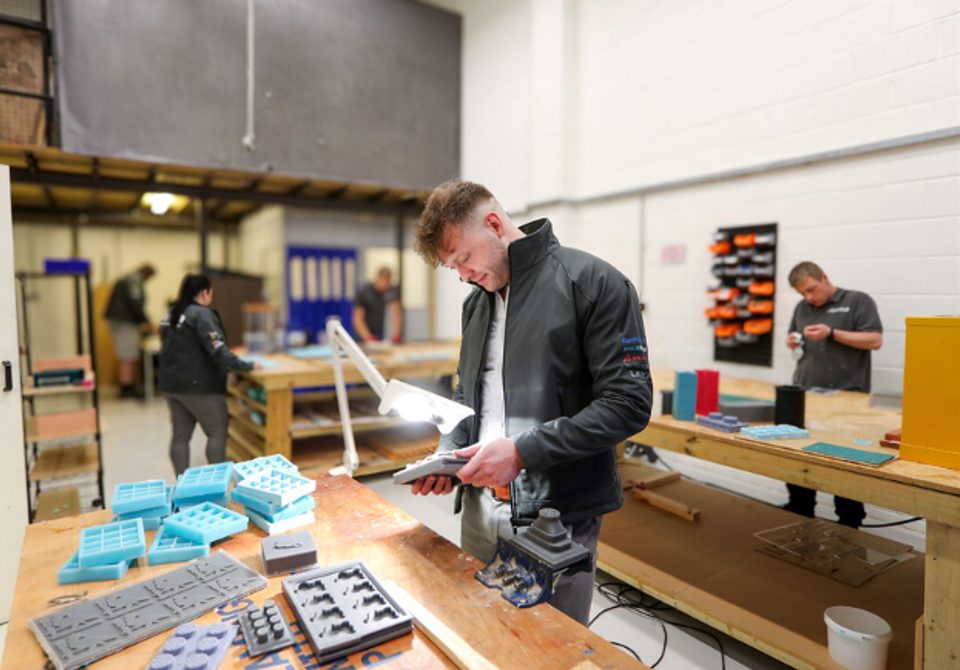
One-off tooling and short runs are quoted the same week where we can. There is no minimum order value and no enquiry we treat as too small to answer.

02

A production programme

Multi-year, scheduled volume with call-off quantities, held stock and a maintained tool. Tell us the annual number and we will price the tool against it.

03

A tool you already own

We take on other people's tooling. We will inspect it, tell you honestly what life is left in it, and either run it or replace it.

04

Something nobody will quote

Awkward geometry, one deep undercut, a part with no drawing. These are the jobs we tend to get because somebody else said no.

One group, four specialisms

TCI Construction is part of TCI Group.

If a project outgrows one division it moves across the group rather than starting again. Decorative tooling goes to TCI Mouldings, volume components to TCI Products.

Not sure which route you need?

Describe the unit. We will tell you the cheapest honest way to cast it.

Send an elevation, a photograph of the original or a sample panel, and we will come back with a route, a material and a price.