Main contractor
A board-marked elevation cast in four lifts
Sawn board grain on an in-situ wall, four lifts from one liner, and a release agent that had to be tested before anything was poured.
Read the jobExample project
A patterned face that had to continue across panel joints, from a set of liners that had to match each other, and stay matched as they wore.
The brief
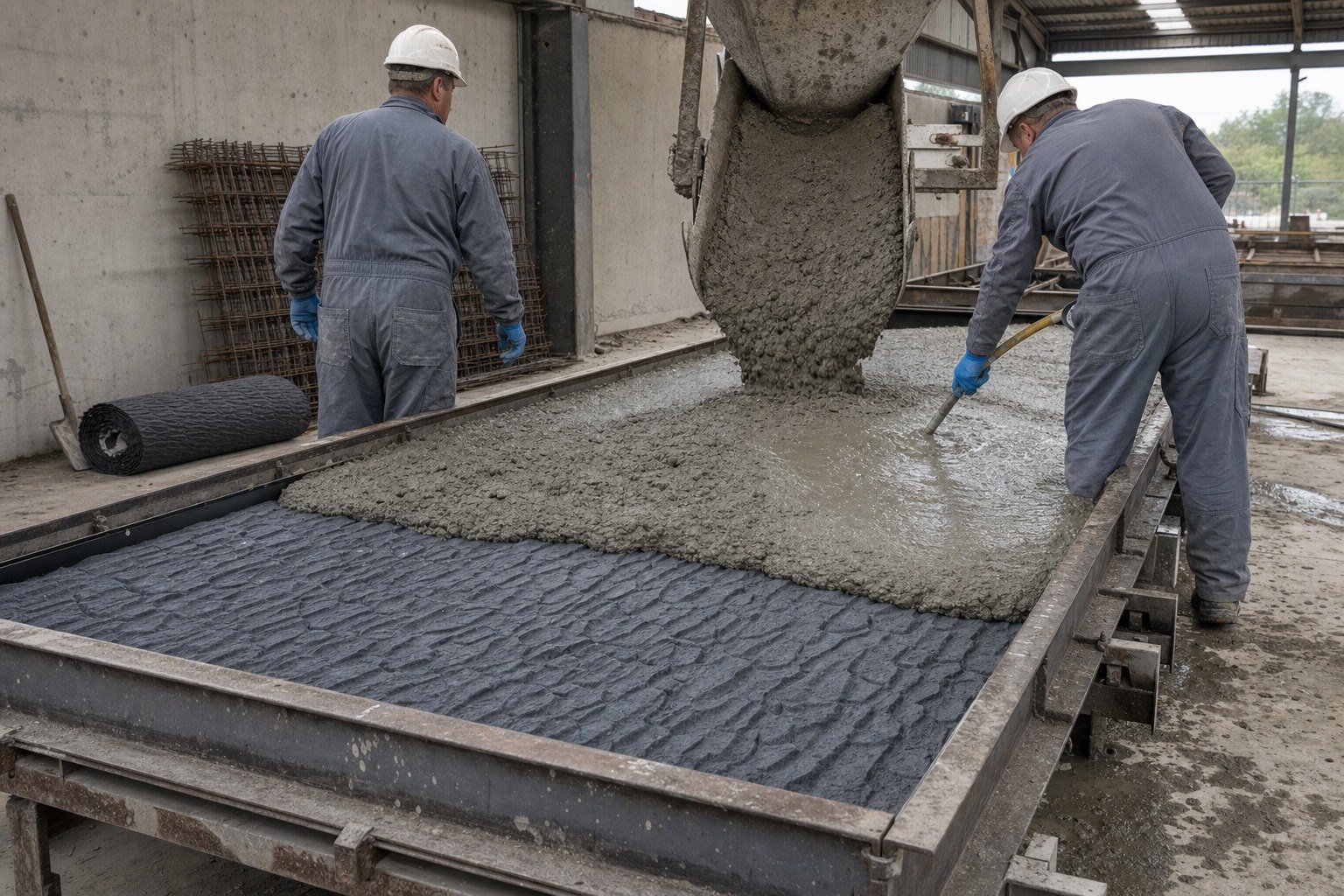
A facade specialist had an elevation where a designed pattern ran continuously across a grid of precast panels. The pattern did not stop at the panel joints, which is easy to draw and is the whole difficulty of the job. The same bay was to be cast around forty times as the frame went up.
The order was for a liner set rather than a liner, because the panels came in more than one size and the pattern had to carry across all of them.
The difficulty
A continuous pattern across panel joints means each liner has to start exactly where the neighbouring liner finished. The tolerance is not the liner, it is everything around it: where the liner sits in the bed, how the bed is set, and how the panel is finally hung. A pattern that is out by a few millimetres at a joint is visible from the far pavement, because the eye follows a line across a joint far better than it judges a texture.
The less obvious problem is that forty pours do not wear a set of liners evenly. If one liner in the set runs every pour and another runs a quarter of them, the panels made late off the busy liner sit next to panels made early off the quiet one, and the same pattern has two different degrees of crispness on one elevation.
There was also a bad habit to head off. On a set like this, someone in a yard will eventually trim a liner in place to make it fit, and a cut on the face prints into every panel made afterwards.
How we did it
We took the pattern as one drawing over the full elevation and cut the liner boundaries out of it, rather than making a liner and repeating it. Each liner in the set carries its own portion, with the joint falling where the pattern gives it the most cover.
Each liner locates positively in the bed off fixed features rather than being measured in each time. Registration then depends on the bed, which is set once and checked, instead of on a repeated measurement made by whoever is on shift.
The liners are rotated through the pours so no single liner takes the whole run. That keeps the crispness of the pattern consistent from the first panel to the last, and it is a scheduling decision rather than a tooling one, so it costs nothing except being told before the run starts.
The liners were made to the size the bed needs, with the edge condition resolved in the tooling, so nobody has a reason to cut on the face. Where a liner needs handling, the handling point is part of the backing.
The numbers
This is the middle preset in the liner calculator on the solutions page, so the sliders will reproduce it.
Take one 8 square metre liner from the set. At an indicative £350 per square metre it is £2,800 of tooling, and forty pours put 320 square metres of finished face on the building. That is £70 a pour, or £8.75 per square metre of face, being £350 divided by forty.
At that level the interesting comparison is no longer tooling against tooling. It is tooling against spoiled panels. The difference between forty clean pours and twenty-five spoiled ones is worth more than the whole liner, which is why the rotation plan and the strike sequence were agreed before the first pour rather than after the first argument.
Where a catalogue texture is acceptable, standard pattern panels are the cheaper route and should be checked first: Betonblock’s published panel prices run from £145 to £270 a panel. A pattern that has to register across panel joints is not a catalogue product. All of the arithmetic below runs at the same indicative rate of £350 per square metre of liner, from published figures from PERI UK and RECKLI. It is a market figure carried here so the division can be checked, and the liner calculator will run it on your own rate instead.
Scroll sideways to see the whole diagram.
Every money figure on this page is indicative. It is taken either from the illustrative two year duty cycle used across all five TCI sites or from published third-party pricing, and it is shown so the arithmetic can be checked. None of it is a quotation, and all of it must be replaced with TCI figures before launch.
Where it got to
The services and the reference material this project drew on.
More jobs
Main contractor
Sawn board grain on an in-situ wall, four lifts from one liner, and a release agent that had to be tested before anything was poured.
Read the jobPrecast manufacturer
Forty millimetres of relief, tight returns, and a face that had to still be casting the same panel at pour one hundred.
Read the jobHousebuilder
Semi-dry units struck green, six profiles in one family, and arrises that had to survive being handled at their weakest.
Read the jobSimilar job?
Send the elevation rather than the panel. The liner boundaries should come out of the pattern, and that only works if we see all of it.