Part of TCI Group · UK design, UK manufacturing capability, since 2019
Concrete moulds and formliners that survive a working yard.
Hand-made and cast silicone moulds, formliners and pattern tooling for precast concrete, GRC, cast stone, plaster, resin and architectural restoration. Specified around your mix and your strike sequence rather than around a catalogue texture.
Nobody buys a formliner. They buy the two hundredth panel looking like the first.
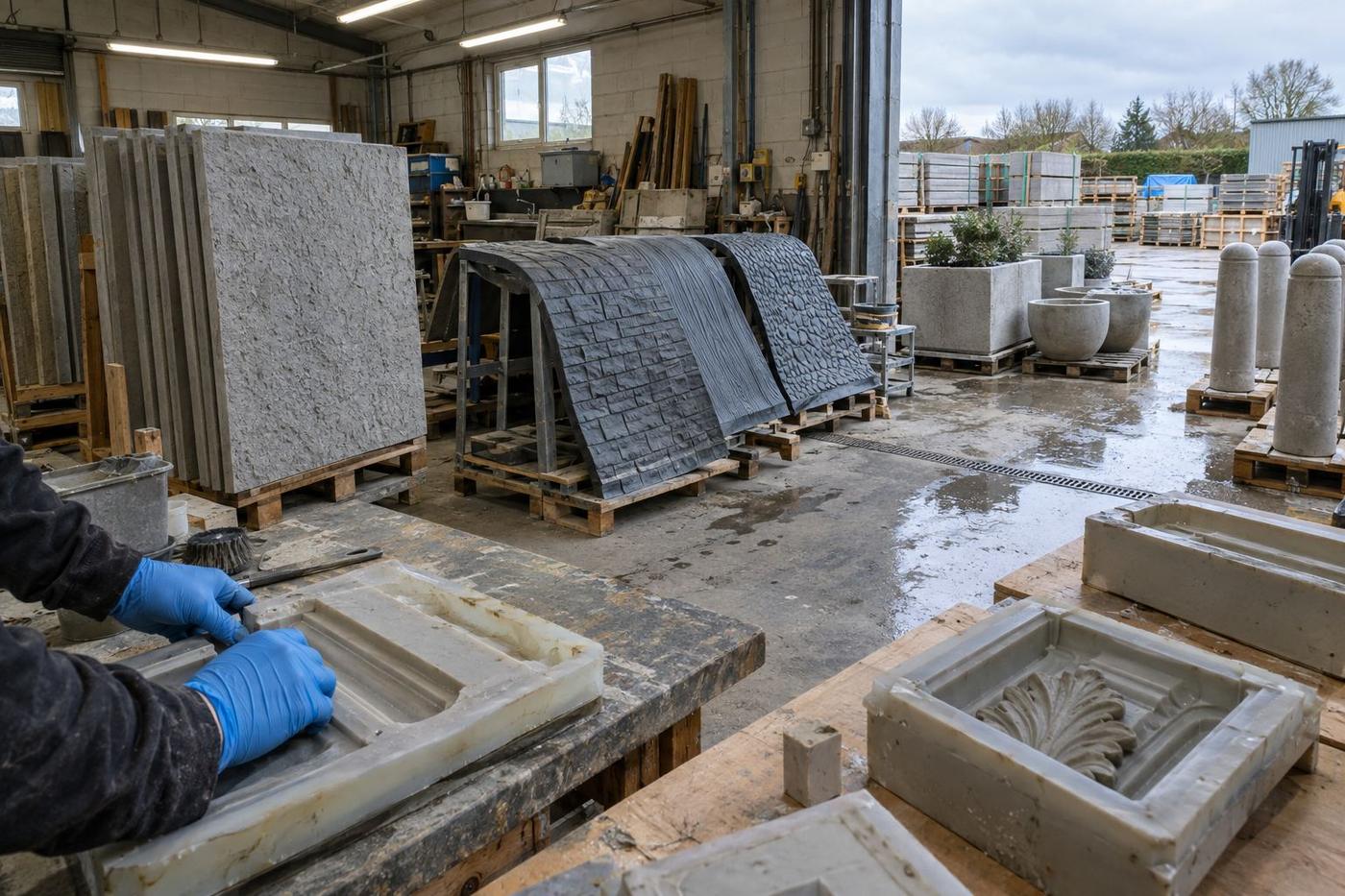
TCI Construction makes silicone concrete moulds, formliners, GRC moulds and architectural restoration moulds. We are the concrete and architectural casting division of TCI Group, working out of our own unit in Bidford-on-Avon, Warwickshire, near Stratford-upon-Avon.
Most enquiries arrive as a problem rather than a purchase order. A liner that has gone tacky and is pulling the face off the concrete. A deep-relief panel that will not release from a rigid mould at all. A weathered corbel that has to be replaced without taking the original off the building. A repeat order where unit nine no longer matches unit one. Every one of those is a specification question about cure system, hardness, backing plus release. All of them are cheaper to answer before the tooling is cut.
So we start at the cast unit and work backwards. What is the mix. How is it compacted. How is it cured. How does the panel come off the bed, who strikes it, and how many do you need before the tool is finished. Only then do we choose the mould material and the moulding route.
One moulding capability. Four different sets of requirements, and a different hardness, backing plus release conversation behind each of them.
Formliners
Texture cast into the concrete
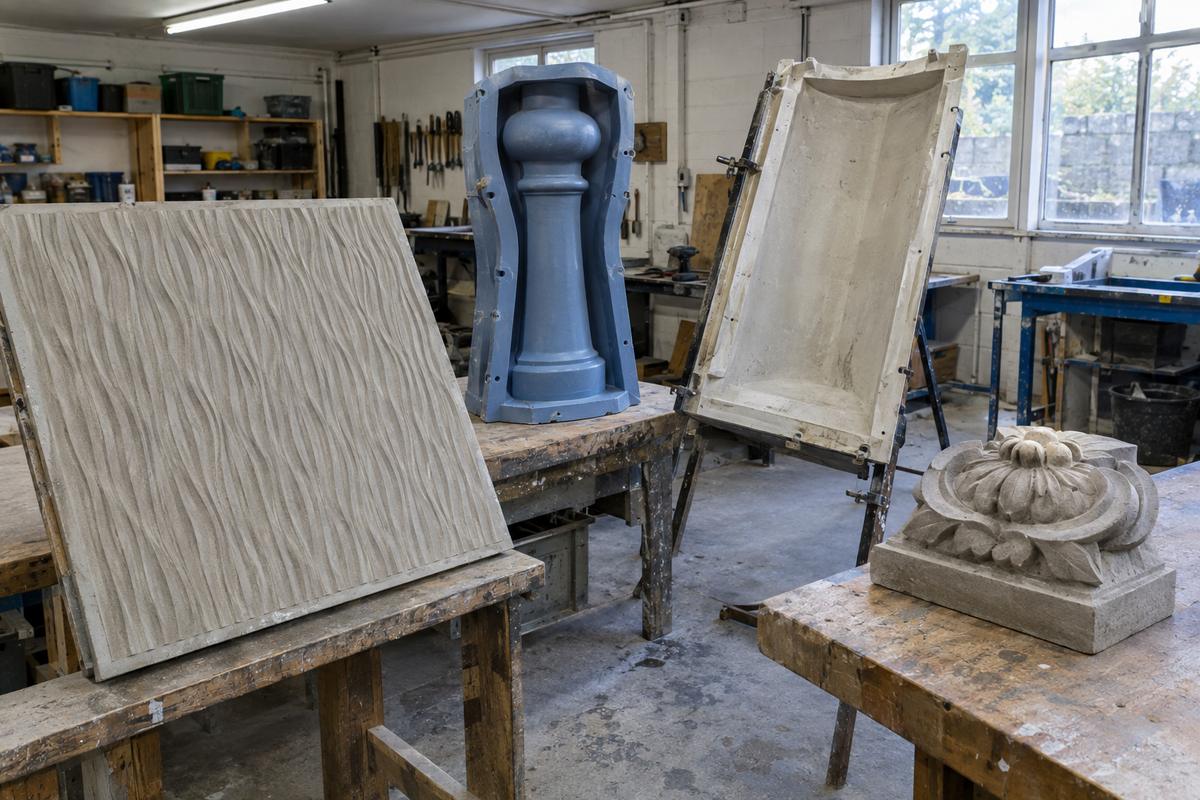
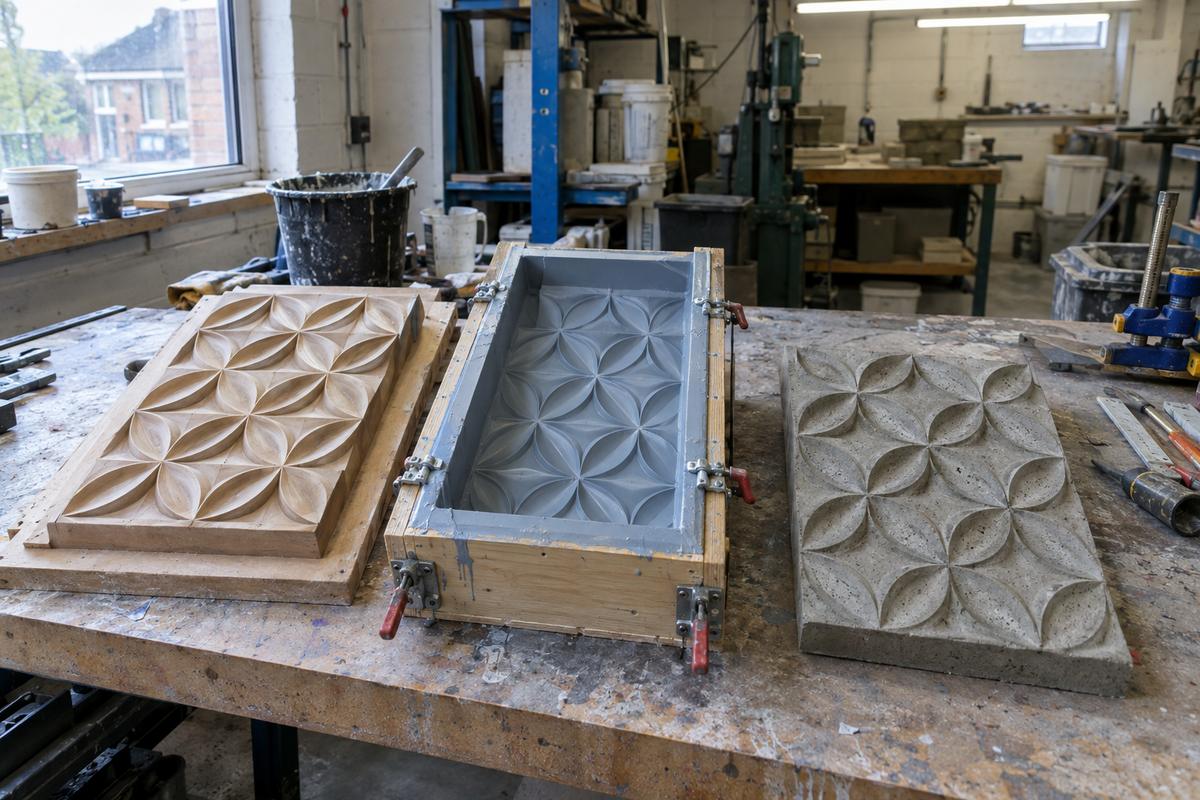
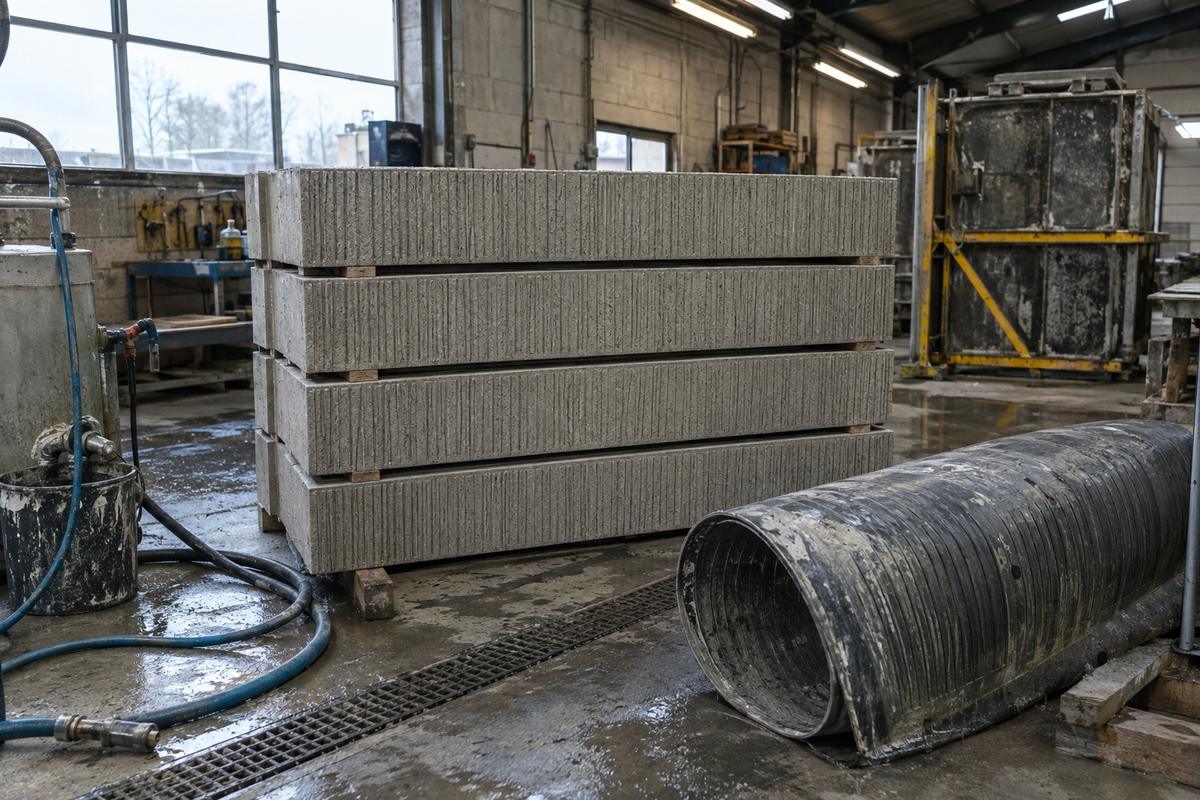
Flexible formliners that cast a face into the panel: split stone, riven slate, board-marked timber, brick, ashlar, custom relief, architect artwork. The liner flexes off the set panel, which is what makes deep relief possible where a rigid mould could never release.
Moulds for cladding panels, copings, cills, lintels, bollards, planters, drainage furniture and one-off architectural units. Repeatability across the run is the whole job, so hardness and backing get specified around handling rather than around the bench.
GRC
GRC moulds for thin shells
Moulds for glassfibre-reinforced concrete facade units: cornices, columns, canopies. The silicone face is only half of it. Hand-lay and spray-up need a rigid frame behind the face or the shell distorts as it is worked.
Restoration
Architectural restoration moulds
Moulding straight off a weathered original so the replacement matches, taken in situ wherever the carving can stay on the building. Soft high-elongation silicone flexes out of undercut that no rigid mould would clear.
Key benefits
Why silicone moulds for concrete, rather than GRP or timber.
Rigid moulds make you simplify the unit until it will release. A flexible face lets you cast what the architect actually drew, and it usually cuts the labour between striking and a saleable panel.
01
Release without fighting the panel
Silicone often needs no chemical release from concrete at all, which is the whole point of it over GRP. Fewer sprayed agents means less surface contamination and fewer blemishes to make good. It also ends the argument over where a stain came from, the mould or the mix.
02
Deep relief and undercut become possible
Because a liner can be flexed off a set panel, the draft angle a rigid mould would demand is not required. Split-stone texture, deep board marking, carved relief. All of it comes off cleanly instead of being shallowed out to suit the tool.
03
Detail that survives repetition
A platinum-cure face holds fine texture and stays dimensionally stable over many casts, so the panels at the end of a facade read the same as the panels at the start.
04
Cost per cast is the number that matters
Reject panels, patching and hand-finishing cost far more across a run than the tooling does. We will tell you when the cheaper liner is a false economy.
Five moulding routes
Which moulding route your concrete job takes is a design decision.
Everything we sell is moulded. Five routes cover it, and for concrete work the first two do most of the heavy lifting: hand-made moulds brushed straight onto a pattern or onto a building, and cast moulds poured face-down onto a pattern plate. The other three sit behind moulded components.
Hand-made moulds, brush-applied silicone built up in layers over a pattern or an original carving. Most restoration work, most deep texture
Cast moulds and cast parts, open-pour and block moulds in silicone or polyurethane. The route behind most formliners and precast unit moulds
Vacuum casting, degassed in the chamber so a fine ashlar or lettered face does not carry a single trapped bubble into every panel
Compression moulding for rubber pavement moulds, kerb moulds, paving moulds, moulded rubber components pressed in a steel tool
Injection moulding, including liquid silicone rubber, where a construction component goes into repeat volume
The pattern itself is printed, machined or hand made, and backing frames are cut and welded here too. None of that is what you buy. It is how the mould gets made, and it is set out in full on hand-made, cast plus vacuum cast mould making.
Textured and patterned face tooling for cladding, spandrel, feature panels. Artwork arrives as a hand sketch, an elevation or a 3D file, and we work from any of them.
Civic
Street furniture and hard landscaping
Rubber moulds for concrete kerbs and paving, plus bollards, planters, drainage furniture and fencing tooling. Genuinely public work the group has delivered, where every unit has to match the last one laid.
Five steps from a drawing or an original to a mould you can run.
Brief and feasibility
We start with the cast unit: mix, compaction, curing, release regime, panel size, run length and how it is struck. Anything that will fight the tooling gets flagged before a pattern is cut.
Design and development
We work from your CAD, a drawing, a sample panel, the physical original or a 3D scan. Relief depth, draft, joint lines, backing and pull direction get resolved with you first.
Pattern and master
The pattern is resin printed, CNC machined or hand made. For restoration work the original itself is usually the pattern, moulded in situ where it can stay in place.
Mould and backing
The face is hand-laid or cast in the agreed material and the rigid backing is built to suit it, which is what stops the panel bowing under the pour.
Trial, handover, then repeat supply
We patch-test against your mix and your release agent rather than assume release. We keep the pattern, so a replacement liner in two years matches the first one.
UK design and UK manufacturing capability
Designed and developed in the UK, with UK manufacturing capability.
We talk about cost per cast, reject panels and how the liner will be stored between pours rather than price per square metre. That is where a precast programme actually loses money.
Design, tool design, pattern making, mould making and inspection all happen at Waterloo Park in Bidford-on-Avon, alongside TCI Mouldings, TCI Culinary and TCI Products. On some larger programmes we place part of the production with partner factories, and who we are and where the work happens explains that in full.
Every mould we manufacture carries a written warranty against manufacturing defect. Material, hardness, backing plus joint detail are all recorded against your order.
NDA as standard
Drawings, artwork, patterns stay yours. We work under non-disclosure by default and your pattern is never run for another customer.
A named engineer
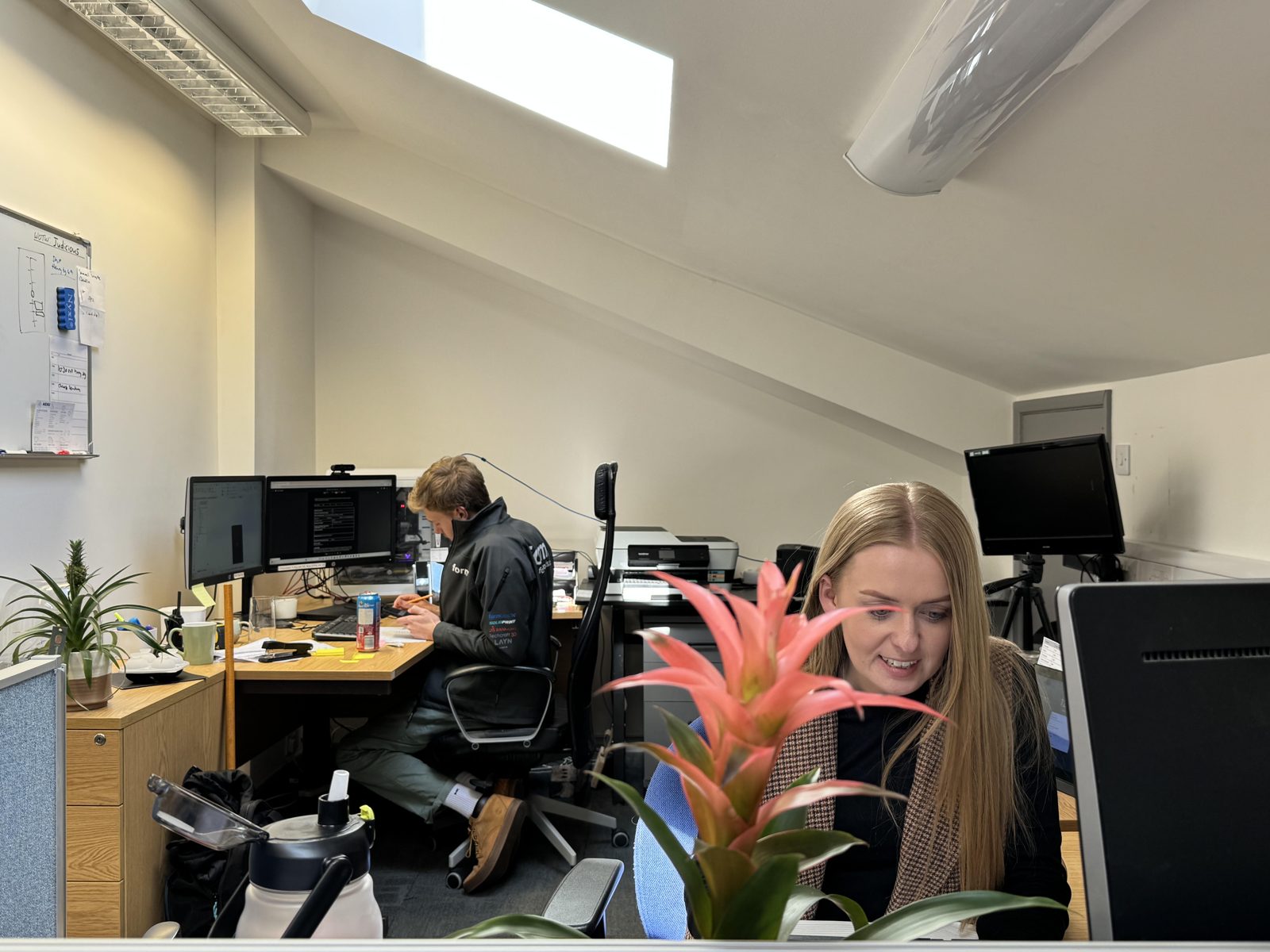
One technical contact from first enquiry through to repeat supply. Someone who knows your mix, your release regime and how your mould was backed, instead of a shared inbox.
Designed and developed in the UK, with UK manufacturing capabilities.
Every job is drawn, specified and engineered at our own facility in Bidford-on-Avon, Warwickshire. We hold the moulding capability here too: hand-made, cast, vacuum cast, compression and injection, with tool making, inspection and finishing in the same building. On some programmes we place part of the production with partners we have used for years. We will tell you which route your job is taking before you order, and how that works is set out on our About page.
Job size
One mould, or a rolling annual programme.
We are set up for long production programmes with a repeat schedule, and we quote them properly: tool cost, unit cost and what happens when the tool wears. That is the work that keeps a workshop like ours stable.
01
A single mould
One-off tooling and short runs are quoted the same week where we can. There is no minimum order value and no enquiry we treat as too small to answer.
02
A production programme
Multi-year, scheduled volume with call-off quantities, held stock and a maintained tool. Tell us the annual number and we will price the tool against it.
03
A tool you already own
We take on other people's tooling. We will inspect it, tell you honestly what life is left in it, and either run it or replace it.
04
Something nobody will quote
Awkward geometry, one deep undercut, a part with no drawing. These are the jobs we tend to get because somebody else said no.
Companies we have worked with
You will have eaten something out of one of our moulds.
These are companies TCI Group has worked with since 2019. We are a small workshop that a number of large manufacturers keep coming back to, which is the only credential we would ask you to weigh.
Construction, civils and facades
SkanskaInternational construction and development group.
A E YatesBolton civil engineering and tunnelling contractor, established 1870.
D4 FacadesUK manufacturer of mechanically fixed brick slip facade systems.
Main contractors, civil engineering firms and facade manufacturers. Concrete work is unforgiving about tooling, and these are the people who tell you so.
Bakery and food manufacture
Finsbury Food GroupOne of the largest speciality bakery groups in the UK.
BBFAmbient cake and chilled dessert manufacturer, five bakeries.
Genesis BakeryMagherafelt bakery, long-standing M&S and Waitrose supplier.
RhokettKent premium cheesecake and dessert producer.
Between them these are own-label suppliers to every major UK supermarket, so a good deal of our food tooling ends up making something you can buy on a Tuesday.
Retail brands and home fragrance
BurberryBritish luxury house.
LushCosmetics manufacturer and retailer.
Candle and home fragrance is a large part of what we mould. That runs from single-room chandlers ordering one mould through to manufacturers running scheduled volume.
Frequently asked
Questions precast yards and architects ask before a first order.
Do I need a release agent with a silicone formliner?
Usually far less than you are used to, and often none at all. Silicone releases concrete mechanically rather than chemically, which is the main reason precast yards move to it from GRP or timber. Where an agent is used, for turnaround or because the mix is sticky, it has to be compatible. A petroleum-based or chemically reactive agent will swell the liner face and shorten its life badly. Tell us what you spray now and we will say whether to keep it.
How many casts will a concrete mould give me?
It depends on the mix, the release regime, how the panel is struck and on the backing behind the face, so we confirm an expected life against your specification instead of quoting a headline number. Cast count on its own is a poor guide anyway. What wears tooling out is alkaline attack from the cement, abrasion from the aggregate, table vibration and the heat of accelerated curing, all working on the face at once. A liner kept on a covered bed and a liner dragged across a yard are not the same product after a season.
Can you take a mould from a weathered original carving?
Yes. It is a large part of the architectural restoration moulds we make. Where the original can stay in place we mould it in situ, so it never leaves the building. Where it can safely come off, we mould it on the bench. Weathered stone is friable, so consolidation and a patch test come first. We can also rebuild detail that has eroded away from a scan before a replacement pattern is cut, so the new unit reads as the original did rather than as the original does now.
Silicone or polyurethane for concrete moulds?
Silicone releases better, holds fine texture and copes with deep undercut, which is why it dominates textured facade work and heritage moulding. Polyurethane is tougher against abrasion and cheaper per litre, so it earns its place on flat high-wear repeat production where the face is not delicate. Plenty of jobs use both: a silicone face for the texture over a polyurethane or resin backing for the structure.
Does a formliner need a backing frame?
Deep-relief liners and GRC moulds almost always do. Silicone is a face material. Without plywood, a welded steel frame or a resin and glassfibre backer, the panel bows under the pour and the geometry drifts across a run. We design the backing at the same time as the face. Retro-fitting stiffness to a liner that has already moved does not work.
Can you match tooling another supplier made?
Usually. Send the old liner, or a cast taken off it, and we can identify the material family, an approximate hardness and how it was backed. Then we rebuild the pattern. Legacy concrete tooling is often specified softer than the job needs. That reads as generosity on the bench and behaves as early distortion in the yard.
One group, four specialisms
TCI Construction is part of TCI Group.
Shared engineering, shared workshop, separate specialisms. The release knowledge behind a chocolate tray is available to a precast yard as well.
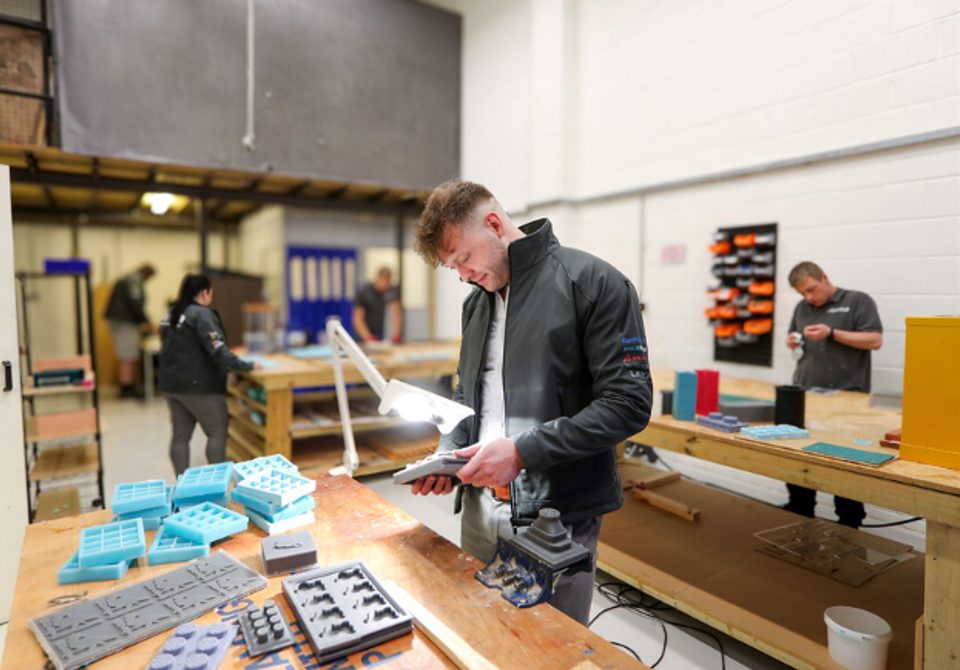
Three photographs taken at the TCI Group unit in Bidford-on-Avon. Elsewhere on the site, where we did not have a photograph of a process or a finished elevation, the picture is illustrative, and the about page names which is which.
Moulded silicone bushes and seals in several colours beside the steel tools that formed them.
Moulded silicone rings, bushes and seals off the bench, laid out before they are checked.
The unit at Waterloo Park standing empty, photographed before fit-out.
Tell us what you need to cast. We will tell you how to mould it.
Send a drawing, an elevation, a photograph of the original or a sample panel. You will get a moulding route, a material recommendation and a price rather than a brochure.