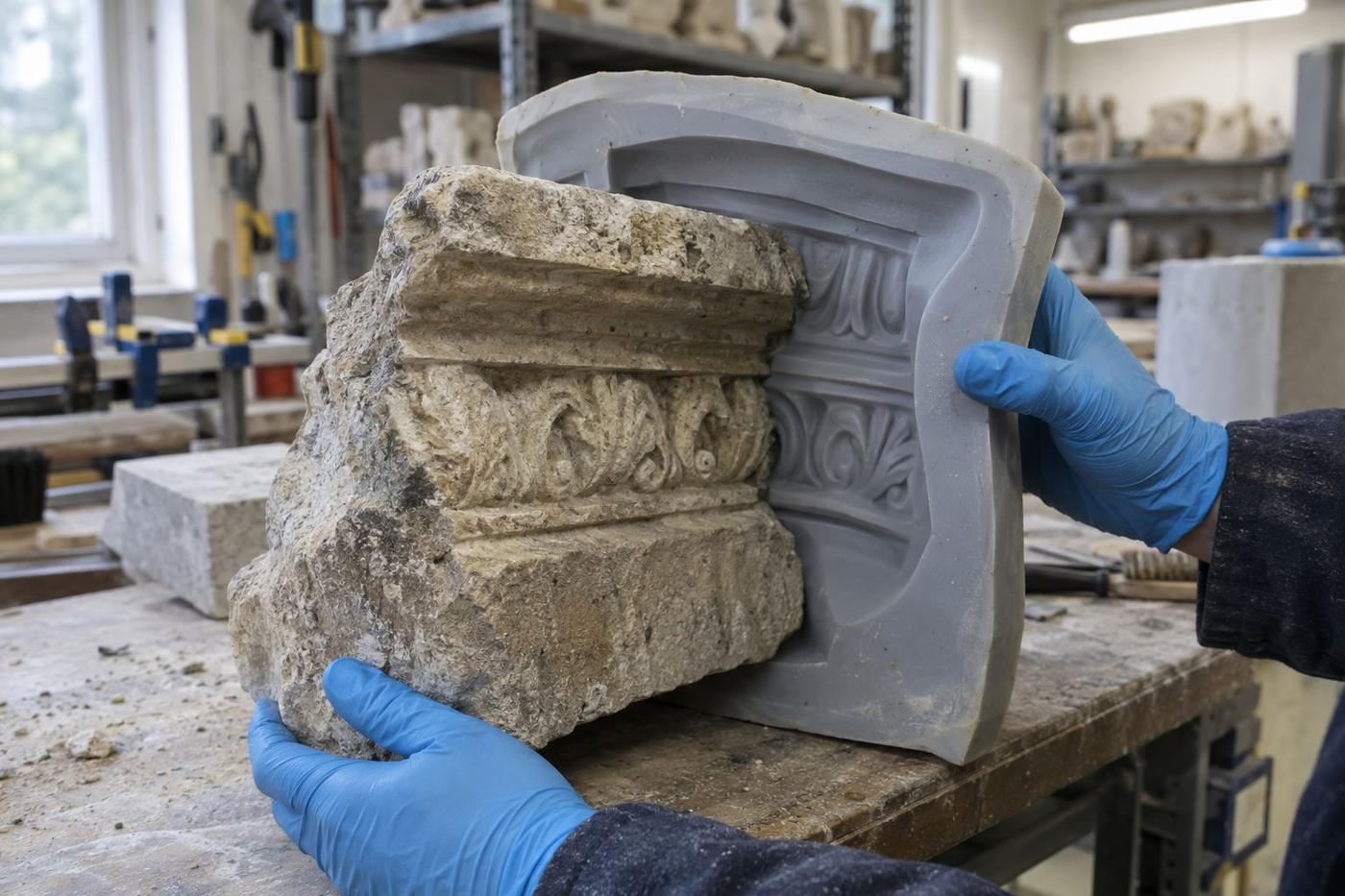
A single surviving section, on the building
Cornice or string course still in place, others failed. We come to site, mould it in situ, and use the mould to reproduce the failed sections.
For heritage restoration · Silicone moulding from a single surviving section
Silicone moulding from surviving cornices, finials, string courses, capstones and keystones — in situ on listed elevations, or on our Warwickshire bench from a section you send us. Reproductions that read as originals, not as replacements.
What matters to you
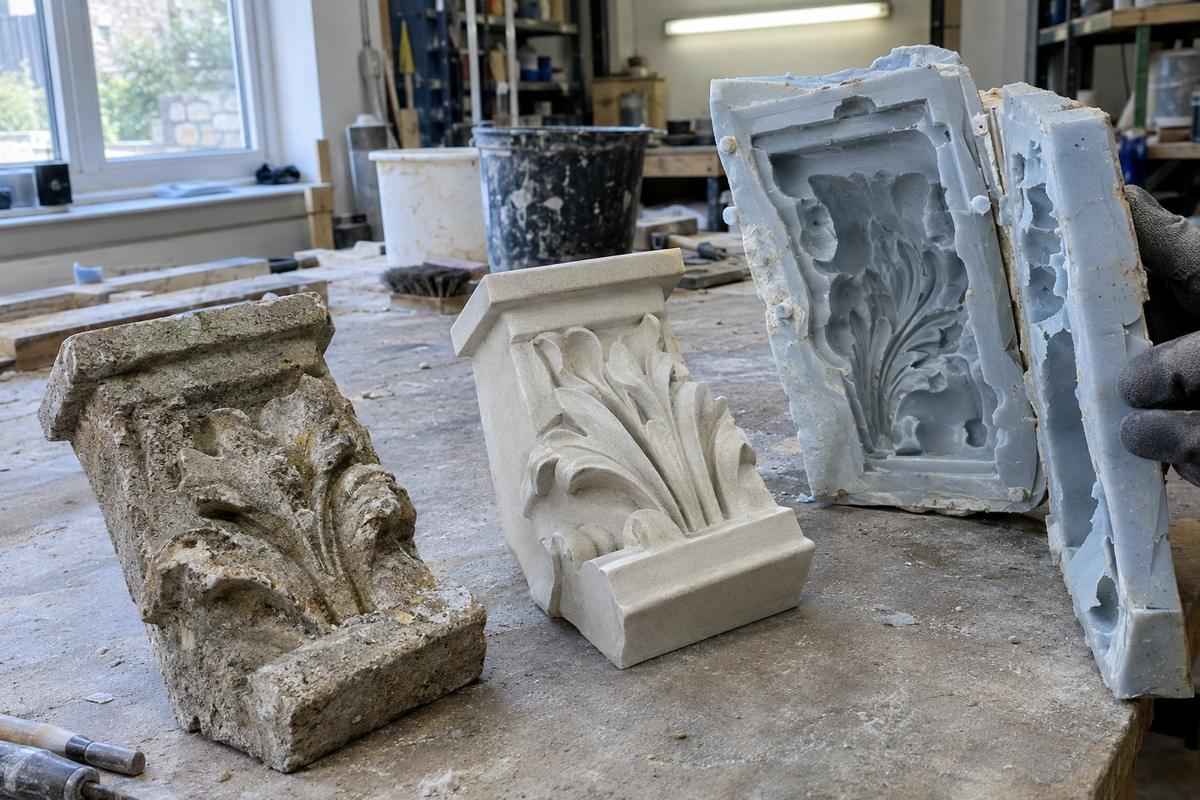
Fidelity to the original — silicone captures weathering, tool marks and small asymmetries that make the reproduction look right. A drawing-based reproduction always looks slightly wrong. A mould from the original does not.
Choice of casting material — silicone is the mould; what you pour into it (concrete, GRC, cast stone with the right aggregate) determines how the reproduction weathers next to the originals. That's a conversation with the conservation officer as much as with us.
Care of the surviving original — in-situ moulding has to leave nothing behind and cause no damage. Bench moulding has to protect the original in transit. We plan for both.
Documentation for the conservation record — every mould we make gets a photographic record, a note of what it was moulded from, and a material spec, so the record shows how the reproduction was arrived at.
How your work looks
Cornice or string course still in place, others failed. We come to site, mould it in situ, and use the mould to reproduce the failed sections.
A finial or keystone removed for safety, or already fallen. We mould it on our bench, then reproduce it in the right material for the reinstatement.
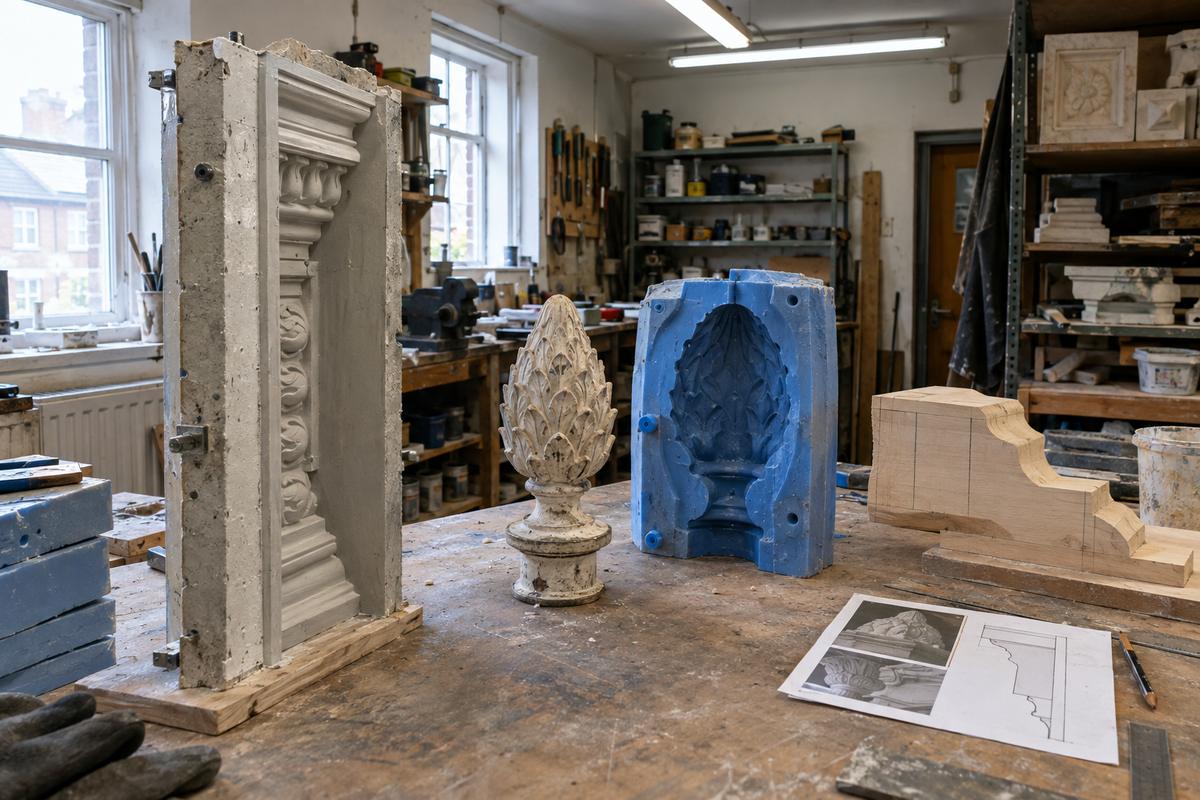
The feature is gone, but photographs, drawings and neighbouring buildings survive. Pattern-making from those sources, then mould from the pattern.
Services that fit
Pattern-making from drawings, photographs, or a surviving section.
Read moreHow the first conversation goes
For listed jobs, we often join the initial site visit with the conservation officer, the specifying architect, and the contractor. It's the fastest way to agree how the reproduction is being made and what the finished pieces should look like.
For jobs that come to us second-hand (through a main contractor or an architect who's already had the conservation conversation), we work to the agreed methodology. If we think there's a better route, we'll flag it — but the decision rests with the conservation team.
For simpler heritage jobs (a garden ornament, a non-listed finial), the conversation is straightforward and quick. We mould, we reproduce, we deliver.
At a glance
How a two-part mould fits together
Swipe to see the whole diagram
FAQs
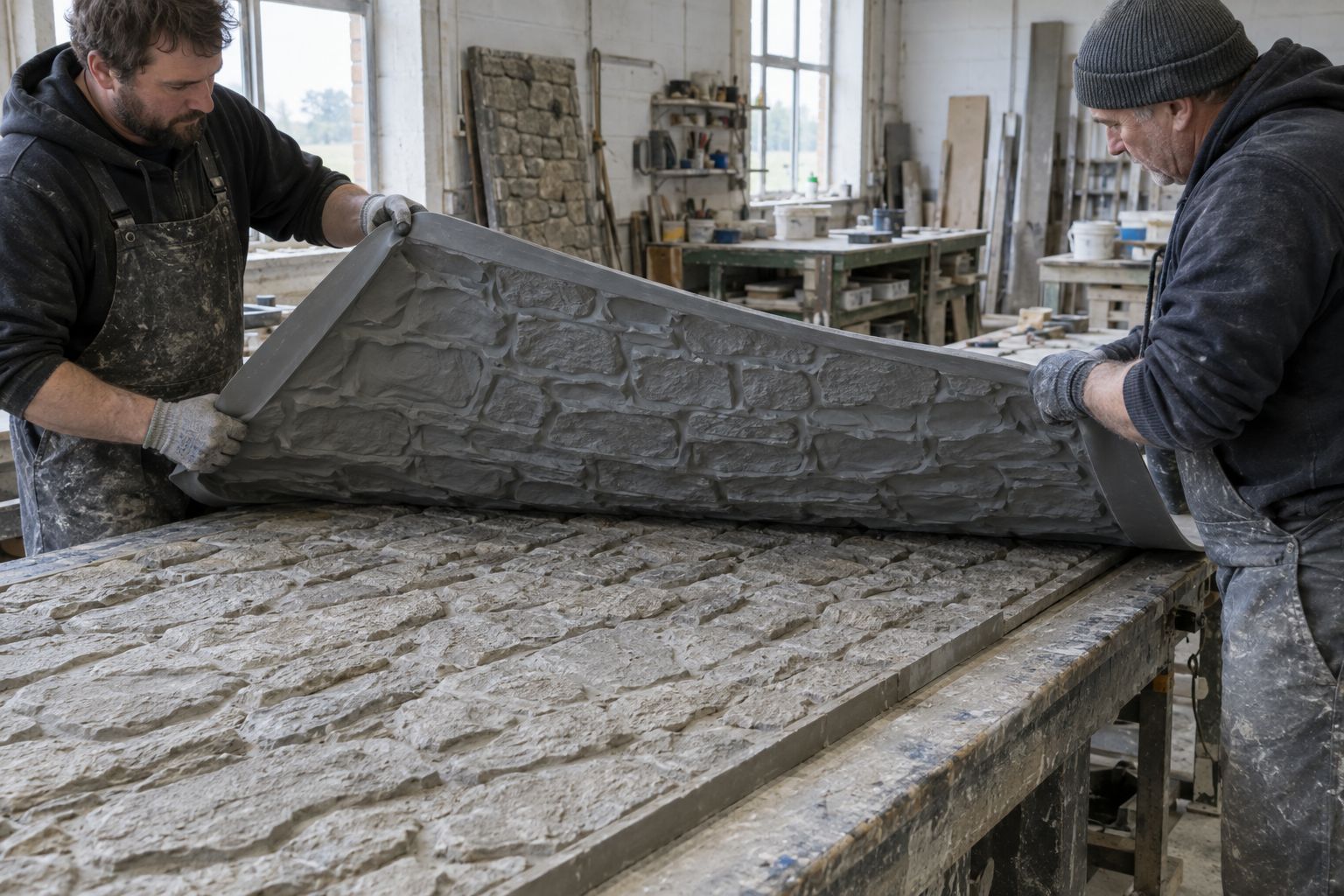
Brush-on silicone applied in layers, thickened so it stays where it's put, backed with a rigid mother mould before it comes off. We've done this many times; the process is well-worked.
No, provided the original is properly prepared. Silicone is chemically compatible with stone; the release regime prevents any physical adhesion. We prepare a small test area first if the stone is particularly friable.
That's a conversation about the casting material — the aggregate, pigment and cement blend used to cast into the mould. We'll help you get it right, but it's not something the mould alone decides.
We attend for anything listed, or where the geometry is complex. For simpler in-situ jobs we can supply the materials and a written procedure if you have a qualified team.
Both routes are possible. Some contractors want the mould and will cast in-house; others prefer us to supply the finished reproductions. We're set up for either.
Get in touch
One photograph tells us what surface you're chasing, and one line about the mix tells us what silicone or polyurethane will survive it.
Real people, a real workshop
No call centre and no middlemen. When you contact TCI Construction, you speak to the team who design, build and check your mould.


 Thomas LaneManaging Director
 George PrestonDesign & Project Manager
 Kelly BallingerHead of Partnerships
 Jim AndertonProduction Manager
 TheodoreEmployee Welfare