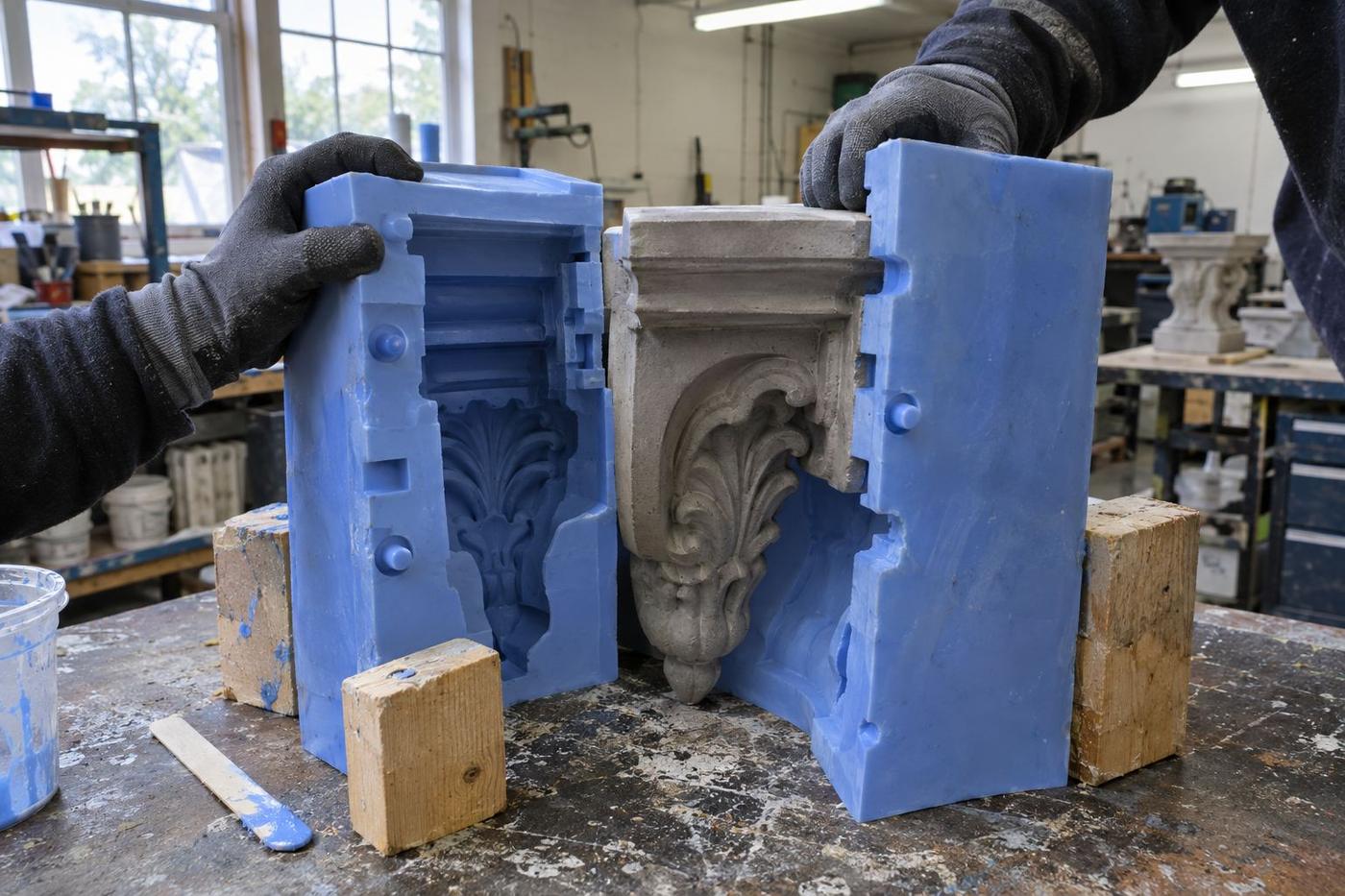
The piece has an undercut
Anywhere the geometry closes back on itself — a coping with a drip, a bollard with a shoulder, a keystone with a rebated back — the piece can't come off a one-piece rigid mould without tearing.
Split moulds · Undercut geometry
When a piece can't lift vertically off a single mould, the tool splits. Where it splits, how the parts key together, and whether the split line reads on the finished face — those are the three decisions we take before we pour a millimetre of silicone.
When it fits
Anywhere the geometry closes back on itself — a coping with a drip, a bollard with a shoulder, a keystone with a rebated back — the piece can't come off a one-piece rigid mould without tearing.
A one-piece silicone can peel over a small undercut, but the peel leaves a mark. A properly split mould with the split on a hidden face gives you a clean unmarked front face.
For a one-off you might get away with sacrificing the mould. For a repeated run, the split has to be matched, keyed and repeatable.
A split mould that comes apart in a controlled way is easier to demould safely than a one-piece silicone that has to be peeled by hand under tension.
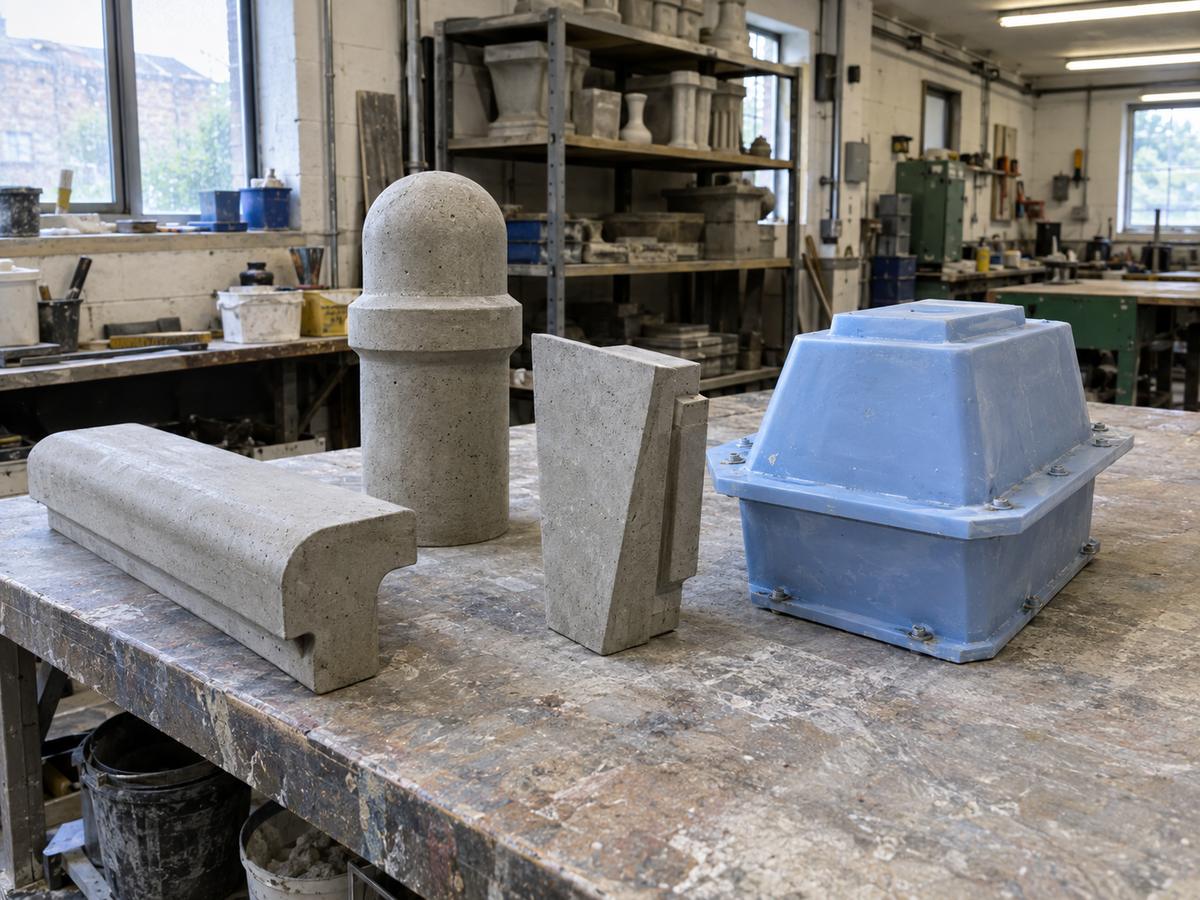
The choice
The split line is decided on drawing before the pattern is built. We look at where the finished piece will be seen from, where the demould pressure has to go, and where the split can be tucked out of sight. On coping and cornice, that's usually the underside or the joint face. On a bollard or bench end, it's often the back.
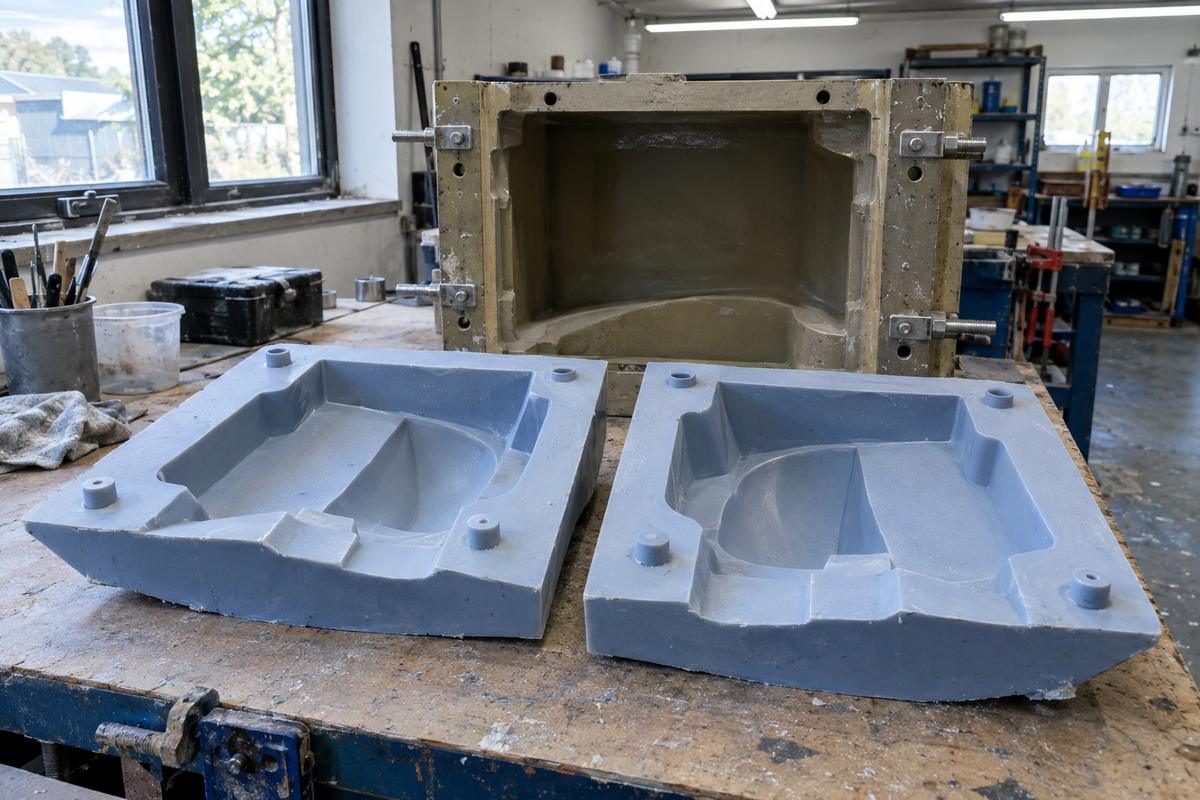
The split faces are flanged so the two halves mate against a wide, flat surface — not a knife edge. That's what stops concrete migrating into the split during pour. The flanges are keyed with matched register bosses so the halves always come back together in exactly the same position.
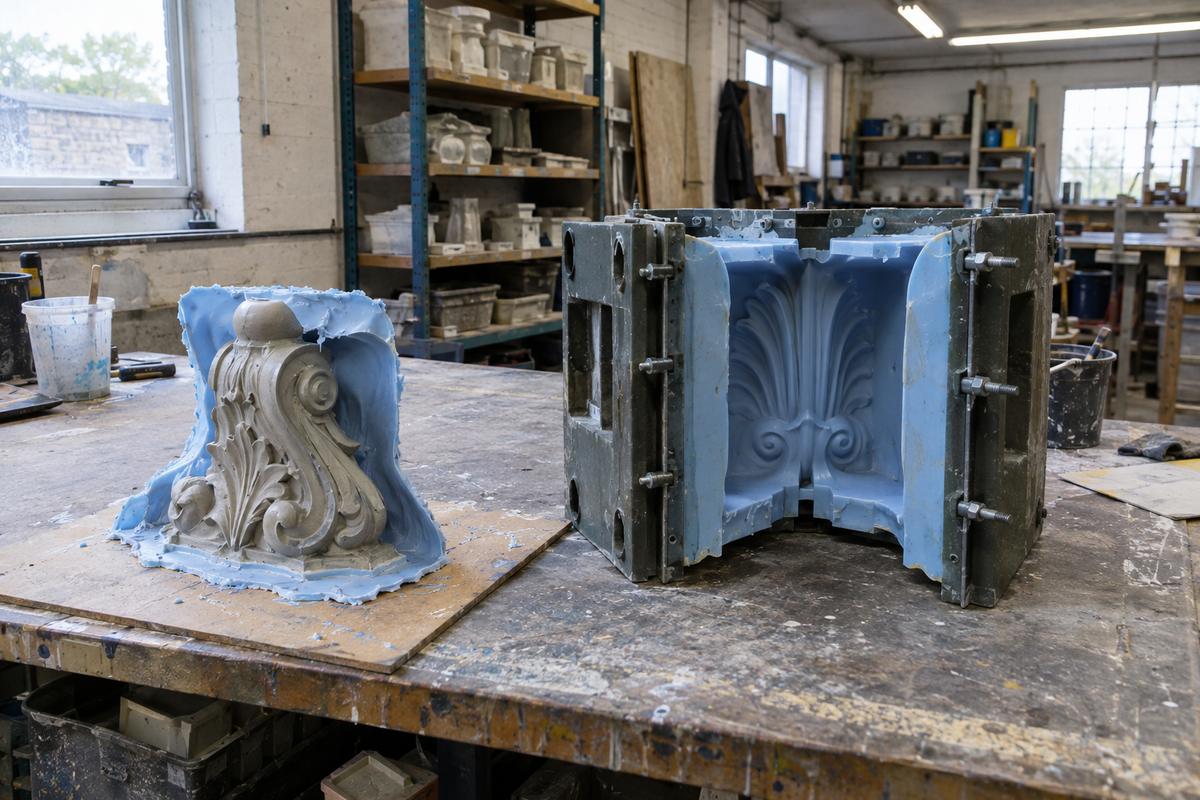
For heavy or repeated pieces, the mould goes into a rigid mother mould or a bolt-up steel or GRP frame. That takes the clamping load off the silicone or polyurethane and puts it onto the frame, which is where the load is meant to go.
What we need
So we can see the closed geometry and decide the split intelligently.
Determines which face has to be witness-line-free.
Determines whether it's a peel-off single-use, a matched two-part with mother mould, or a bolt-up frame.
Two operatives, vacuum lift, roll-out. Determines flange size and clamp regime.
The honest bit
A split mould costs more than a one-piece mould, and it takes longer to build. The trade-off is that it gives you undercut geometry with a clean face and a repeatable demould — which for anything you're pouring more than a handful of times is the right economics.
For a one-off restoration piece we'll sometimes recommend a sacrificial single-use silicone rather than a proper split — cheaper, faster, and there won't be a repeat. We say so upfront rather than sell the more expensive tool.
Related
At a glance
How a two-part mould fits together
Swipe to see the whole diagram
Get in touch
One photograph tells us what surface you're chasing, and one line about the mix tells us what silicone or polyurethane will survive it.
Real people, a real workshop
No call centre and no middlemen. When you contact TCI Construction, you speak to the team who design, build and check your mould.


 Thomas LaneManaging Director
 George PrestonDesign & Project Manager
 Kelly BallingerHead of Partnerships
 Jim AndertonProduction Manager
 TheodoreEmployee Welfare