Bidford-on-Avon, Warwickshire. Mon to Fri.01789 224228

Knowledge · Materials guide

Choosing between silicone and polyurethane for concrete.

The short version: polyurethane is the workhorse for concrete, silicone earns its keep on fine detail and undercuts. The long version, with the reasoning, follows.

GuidePlain English
Read~6 minutes
UKMade
2026Updated

Start here

There's no universally right answer.

Silicone mould and polyurethane liner shown as practical workshop materials
Silicone and polyurethane each suit different jobs

Anyone who tells you silicone is always better, or that polyurethane is always cheaper per pour, is oversimplifying. Both materials have earned their place on the bench, and the right one depends on what you're casting, how many, and how the tool is being handled.

This guide walks through the honest trade-off in the language of the yard, not the marketing brochure. If you finish it and you still can't tell which one your job needs, ring us and describe the panel.

Polyurethane

Four situations where polyurethane is the right answer.

01

Repeat runs of straightforward relief

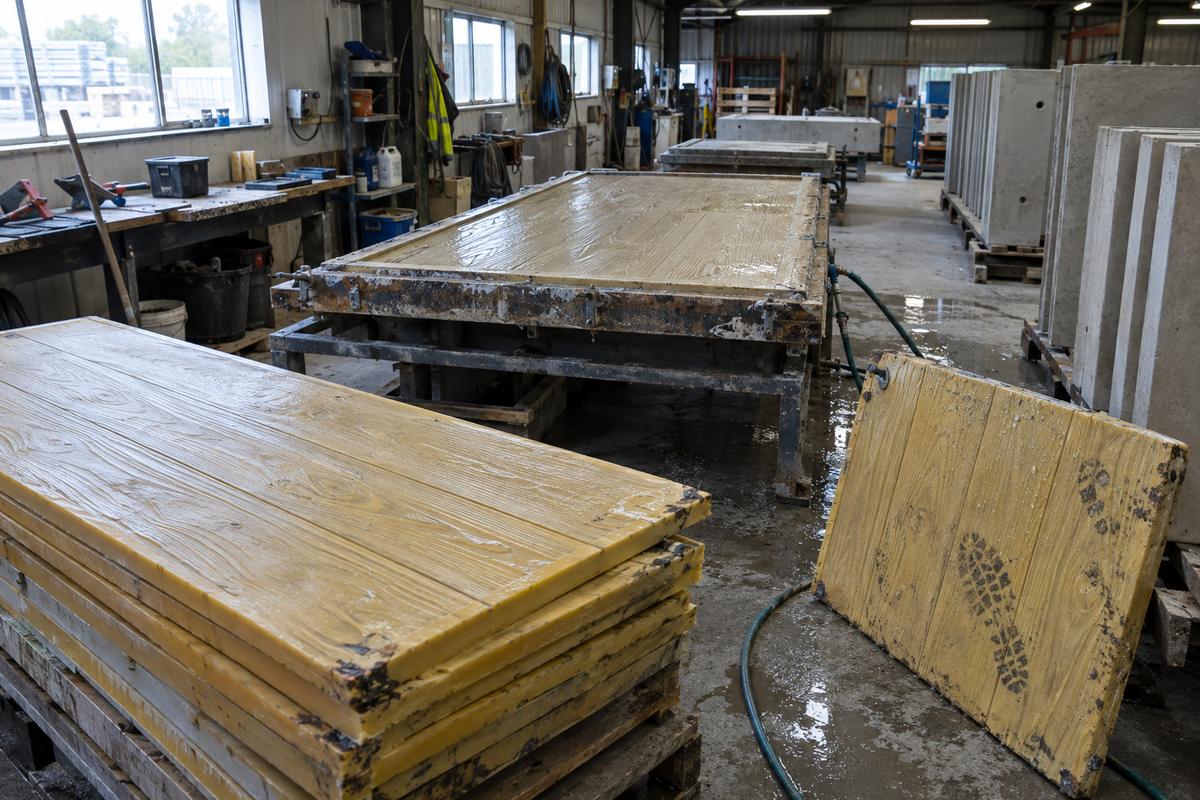
A wood-grain formliner running hundreds of pours on ordinary OPC precast. Polyurethane costs less per square metre, lasts longer under repeat handling, and doesn't need coddling. This is where polyurethane genuinely wins.

02

Heavy handling in a busy yard

Formliners that get vacuum-lifted, hosed with cold water, stacked outside, walked on by mistake. Polyurethane takes abuse that would nick a silicone tool. If your yard is rough on tooling, spec polyurethane.

03

Cost-sensitive programmes

Where the customer has a tight budget and the relief doesn't need silicone's detail, polyurethane can save meaningful money on the tooling line. Not free — nothing decent is free — but noticeably less than silicone at the same size.

04

Long shallow reliefs

Board-marked concrete, sawn-timber texture, subtle stone facing. All shallow, no undercuts, no fine detail. Polyurethane holds these easily and outlasts silicone in the same application.

Polyurethane formliners in a busy yard with repeat precast panels
Polyurethane suits repeat runs and rough yard handling

Silicone

Four situations where silicone is worth its extra cost.

01

Fine architectural relief

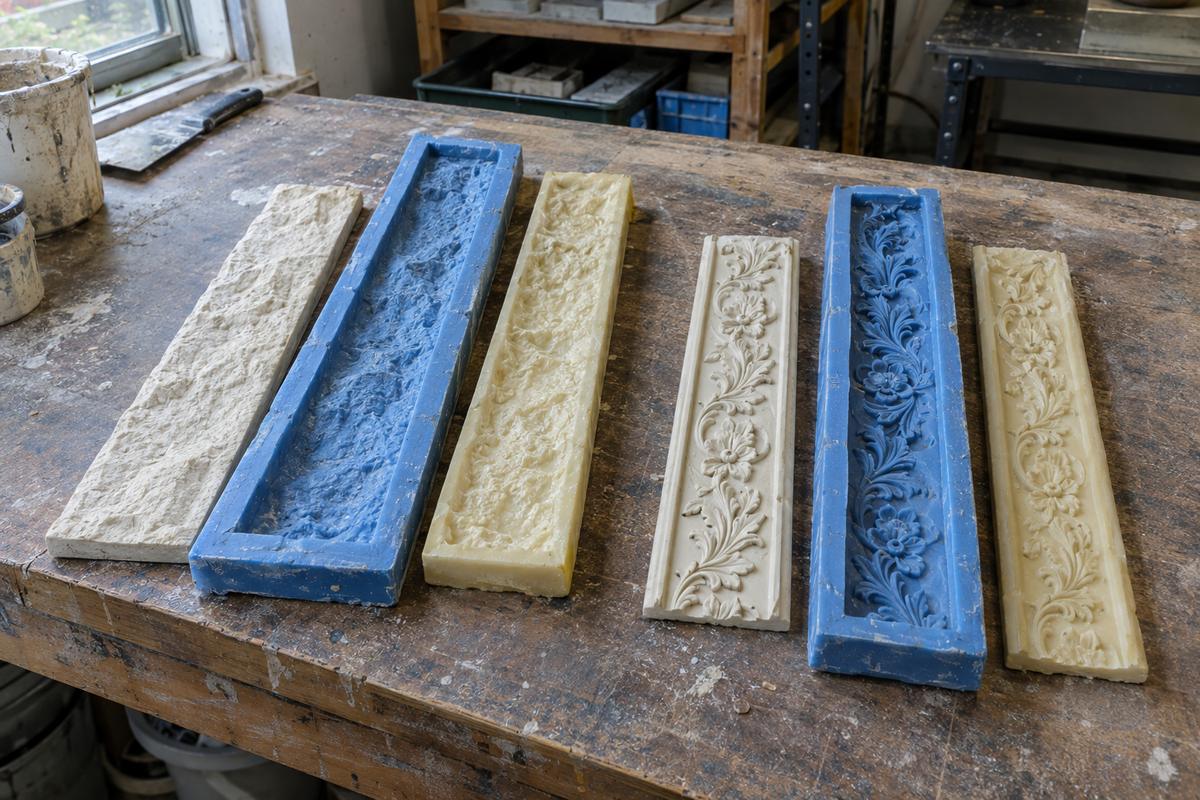
A cladding panel with rope detail, foliage, deep-carved letters or crisp geometric edges. Silicone captures fine detail that polyurethane blurs. Every micron of the pattern reads on every panel.

02

Any undercut geometry

Anything the mould has to flex past to release — cornices, deep coffers, three-dimensional bosses. Silicone flexes past undercuts that would jam a polyurethane tool or force you into a two-part mould you didn't want.

03

Heritage reproduction

Rebuilding a lost cornice or finial from a surviving section. Silicone captures the weathering and tool marks that make the reproduction look right. Polyurethane loses those subtleties.

04

Aggressive or pigmented mixes

Some GRC face-mixes and some heavy pigment loadings degrade polyurethane faster than they degrade silicone. If your mix chemistry is unusual, silicone often survives longer despite costing more up front.

The trade-off

How the cost per pour actually works out.

Polyurethane on straightforward relief. Lower cost per square metre, high pour count, low handling risk. Cost per pour is typically the lowest of any moulding route on this kind of work.

Silicone on the same relief. Higher cost per square metre, similar or slightly higher pour count, similar handling risk. Cost per pour is higher than polyurethane. If the relief doesn't demand silicone, this is where you're overspending.

Polyurethane on fine detail. Lower initial cost, but with a shorter usable life because fine details wear or blur faster in polyurethane than silicone. Cost per pour looks decent early, then rises as replacements come sooner.

Silicone on fine detail. Higher initial cost, longer usable life on fine detail. Cost per pour is often lower over a full programme than polyurethane on the same detailed job — the maths flips.
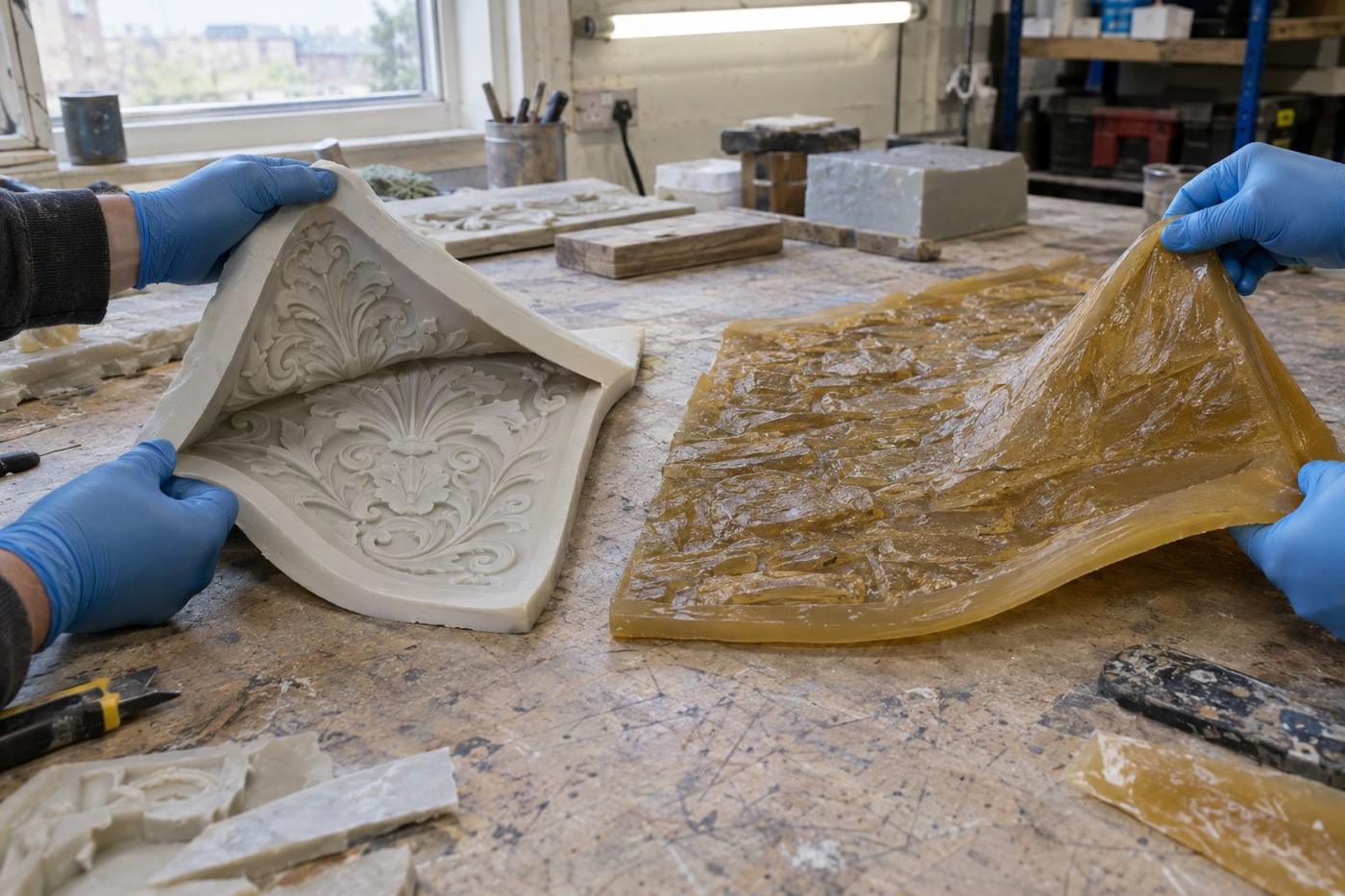
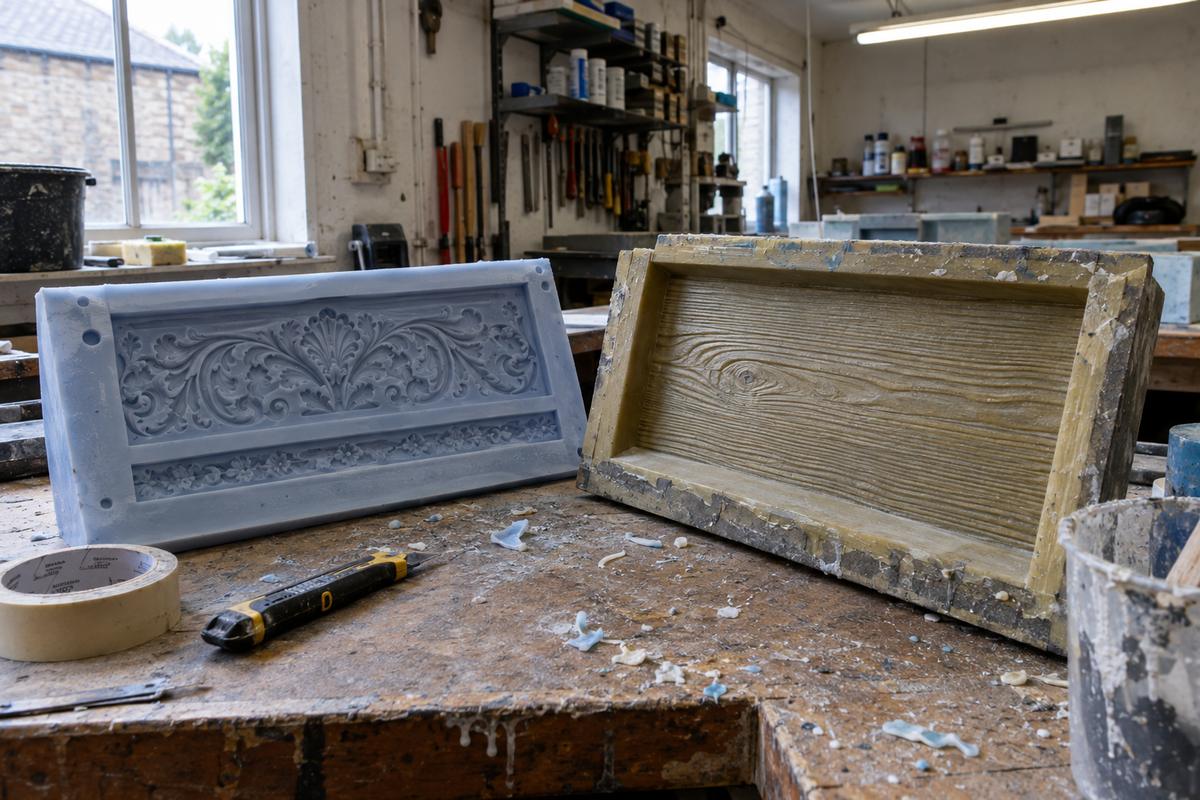
Fine and simple relief samples comparing silicone and polyurethane wear

Honest bit

There's a middle case where either would work.

For a lot of jobs — moderate relief, moderate pour count, moderate handling — either material would give you a decent tool. In that case the deciding factor is usually the price you're comfortable paying up front, and whether the visual bar is really that low or you're being modest about your expectations.

If it's genuinely a coin flip, we default to polyurethane, because the total cost usually works out lower and the tool tolerates the yard better. But we'll say if we think silicone is quietly the better answer for a specific piece.

At a glance

The idea in a picture.

How a two-part mould fits together

Pour spoutAir ventSplit lineYour part in the cavityFlexible siliconeRigidmother mould

Swipe to see the whole diagram

The silicone holds the detail, the rigid case keeps it true, and the split line lets the part come out without tearing.

FAQs

Common questions on this choice.

Can we mix silicone details into a polyurethane mould?

Yes. Silicone inserts set into a polyurethane surround are a very common solution. You get silicone detail where it matters and polyurethane elsewhere, saving cost.

Does silicone always outlast polyurethane?

No. On simple relief with lots of handling, polyurethane often outlasts silicone. Silicone's edge is on detail and undercuts, not on raw pour count.

Can we start with polyurethane and upgrade to silicone later?

Yes, if the pattern is preserved. We can pour a polyurethane tool, and if you decide later you need silicone for a subsequent run, cast that from the same pattern.

Is one easier to demould than the other?

Silicone is more forgiving on complex geometry because it flexes past undercuts. On flat or gently curved pieces the difference is small.

What about EPDM or natural rubber for concrete?

Older formliner tradition used rubber compounds. They still exist, but for most modern applications silicone and polyurethane have overtaken them on cost, life and consistency.

Get in touch

Send us a photograph of the panel or the elevation.

One photograph tells us what surface you're chasing, and one line about the mix tells us what silicone or polyurethane will survive it.

Real people, a real workshop

You deal with the people who make it.

No call centre and no middlemen. When you contact TCI Construction, you speak to the team who design, build and check your mould.

  • A real Warwickshire workshopUnit 15, Waterloo Park, Bidford-on-Avon, Alcester B50 4JG.
  • Real people on the phoneCall the team on 01789 224228, Monday to Friday.
  • The same team on every jobDesign, production and aftercare come from the people you see here.
  • Part of TCI GroupFive specialist brands, one engineering team. Visit TCI Group.
The TCI design and project office.
The TCI workshop, with moulds on the bench mid-build.
  • Thomas LaneManaging Director
  • George PrestonDesign & Project Manager
  • Kelly BallingerHead of Partnerships
  • Jim AndertonProduction Manager
  • TheodoreEmployee Welfare
Meet the team