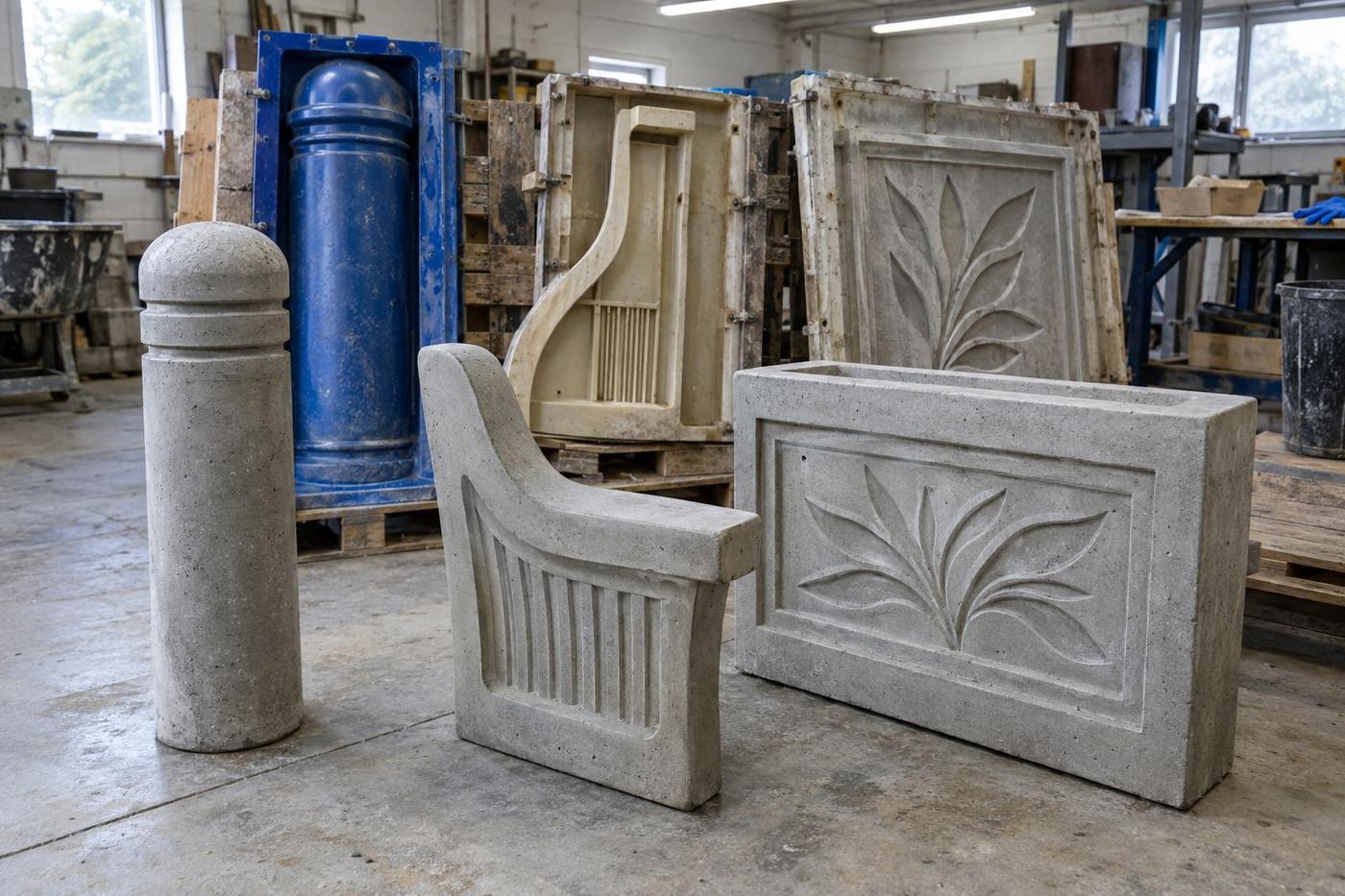
Signature street furniture
Bespoke bollards, bench ends and seating walls carrying a scheme's identity. Usually a split mould for the undercut geometry, with a silicone face for the relief.
For public realm projects · Street furniture and place-making
Bespoke bollards, bench ends, planters and paving inserts for regeneration schemes. Designed with the landscape architect, cast by your precaster, and built to be reordered when a lorry reverses into one in five years' time.
What matters to you
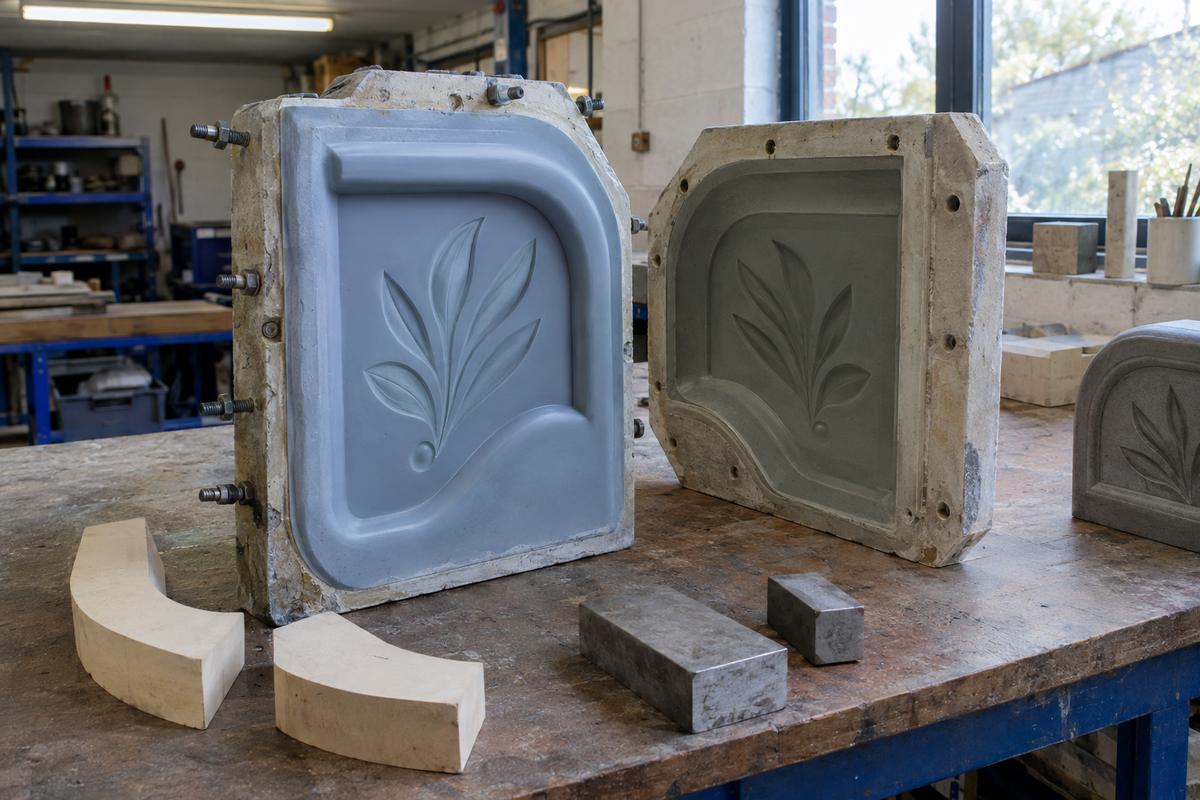
The design intent has to survive to site. A landscape architect draws a bench end with a particular edge radius and a relief motif that ties to the local story. The mould is what carries that intent from the drawing to four hundred castings on the street. We work to the design team's drawings and send physical pattern approvals back to them, not just to the contractor.
The pieces live outside and take abuse. Vehicle strikes, skateboards, grit, frost and the odd angle grinder. Arrises need a sensible radius, reliefs need to be deep enough to survive weathering, and the mould has to produce a dense, well-compacted face every time.
Replacements are guaranteed to be needed. Councils want to know that when a bollard is taken out by a delivery van, a matching one can be cast. That's why the drawing, pattern and material spec stay on our file for the life of the scheme.
How your work looks
Bespoke bollards, bench ends and seating walls carrying a scheme's identity. Usually a split mould for the undercut geometry, with a silicone face for the relief.
Large-format planters and tree-pit edges cast in the precaster's yard. Built with drainage and lifting points designed in, not drilled afterwards.
Inlaid relief panels, wayfinding motifs, heritage trails set into the paving. Shallow relief polyurethane tooling that runs well.
Services that fit
How the first conversation goes
Most public realm enquiries reach us from one of three people: the landscape architect at design stage, the main contractor at procurement, or the precaster who's won the package. Any of the three is fine. We'll ask who else is in the chain so the drawing approvals go to the right person.
Send the furniture drawings and the quantity schedule. We'll come back with a route per piece (one-piece, split, or silicone-faced), what we'd need from the design team to build a pattern, and how the approval stage would work.
Where the design is still moving, we can build a pattern early for a physical review. It's a quicker way for a design team to agree an edge radius than trading PDFs.
At a glance
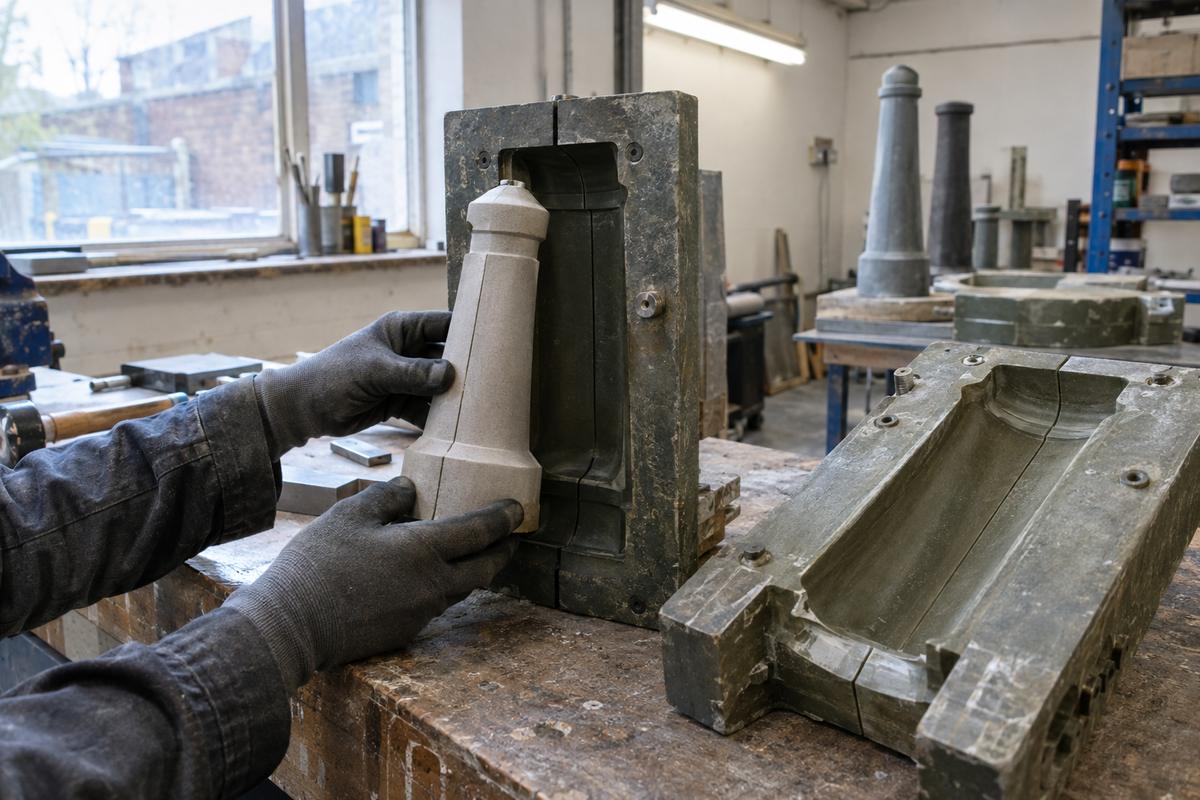
How a two-part mould fits together
Swipe to see the whole diagram
FAQs
Yes. We prefer it. Pattern approvals go faster when the person who drew the piece can see and touch it.
Whoever pays for it — usually the precaster or the contractor. We'll note on file who the client authority is so replacements can be traced years later.
Yes. Hand-drawn or school-project artwork can be scanned and turned into a relief pattern. We'll advise on minimum line width so it survives weathering.
No. We make the tooling. Your precaster casts. We're happy to recommend precasters we've worked with if you don't already have one.
It can be built into the mould — skate stoppers, sloped tops, chamfered arrises. Better designed in than bolted on.
Get in touch
One photograph tells us what surface you're chasing, and one line about the mix tells us what silicone or polyurethane will survive it.
Real people, a real workshop
No call centre and no middlemen. When you contact TCI Construction, you speak to the team who design, build and check your mould.


 Thomas LaneManaging Director
 George PrestonDesign & Project Manager
 Kelly BallingerHead of Partnerships
 Jim AndertonProduction Manager
 TheodoreEmployee Welfare