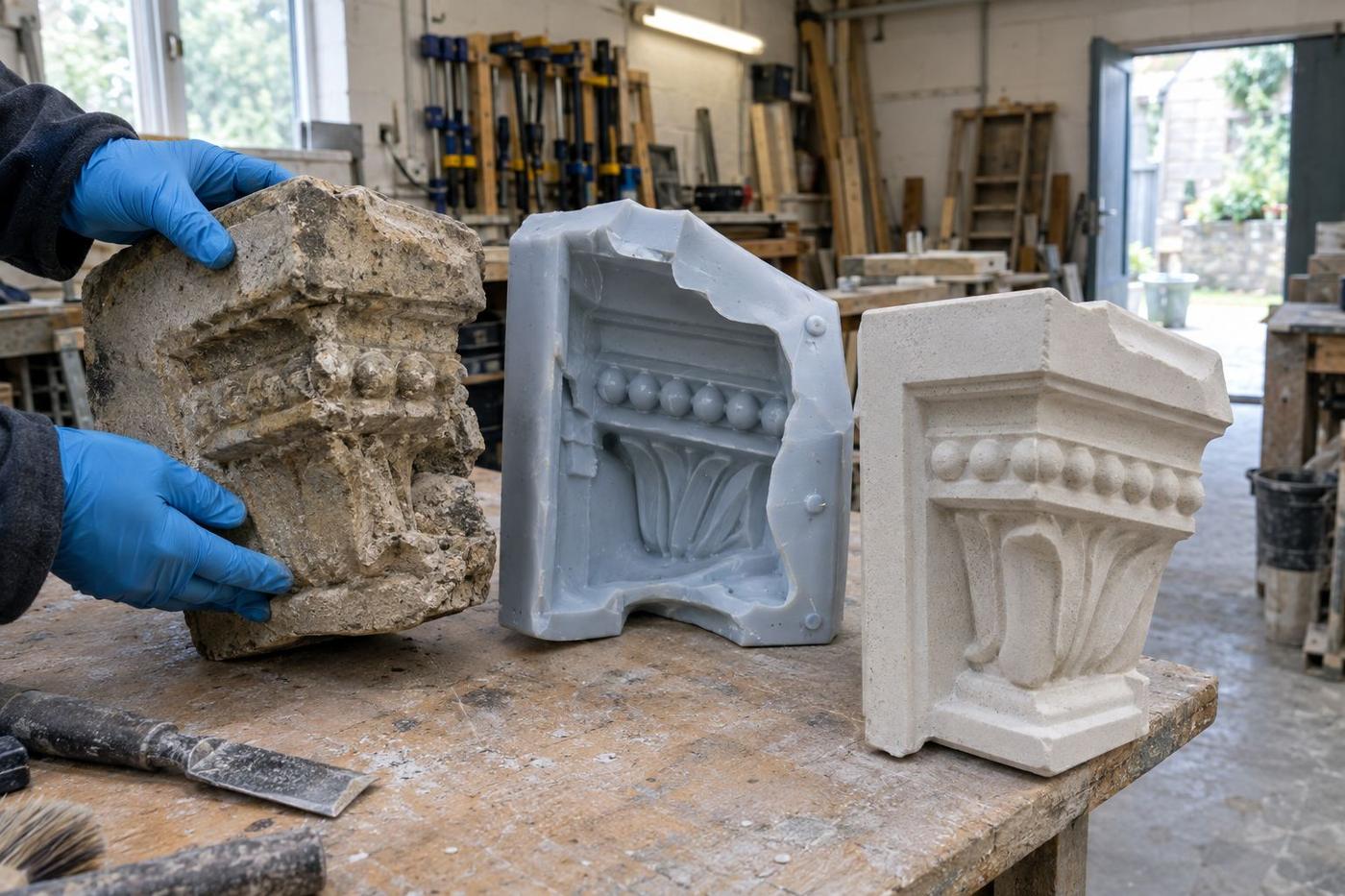
Sample survives on the building
A cornice, string course or capstone still in place while its neighbours have failed. We mould from it in situ, then use the mould to reproduce the failed sections in matching material.
Knowledge · Heritage guide
One surviving cornice, finial or keystone is enough to rebuild an entire elevation of losses. Here's how the process works, in plain language.
The principle
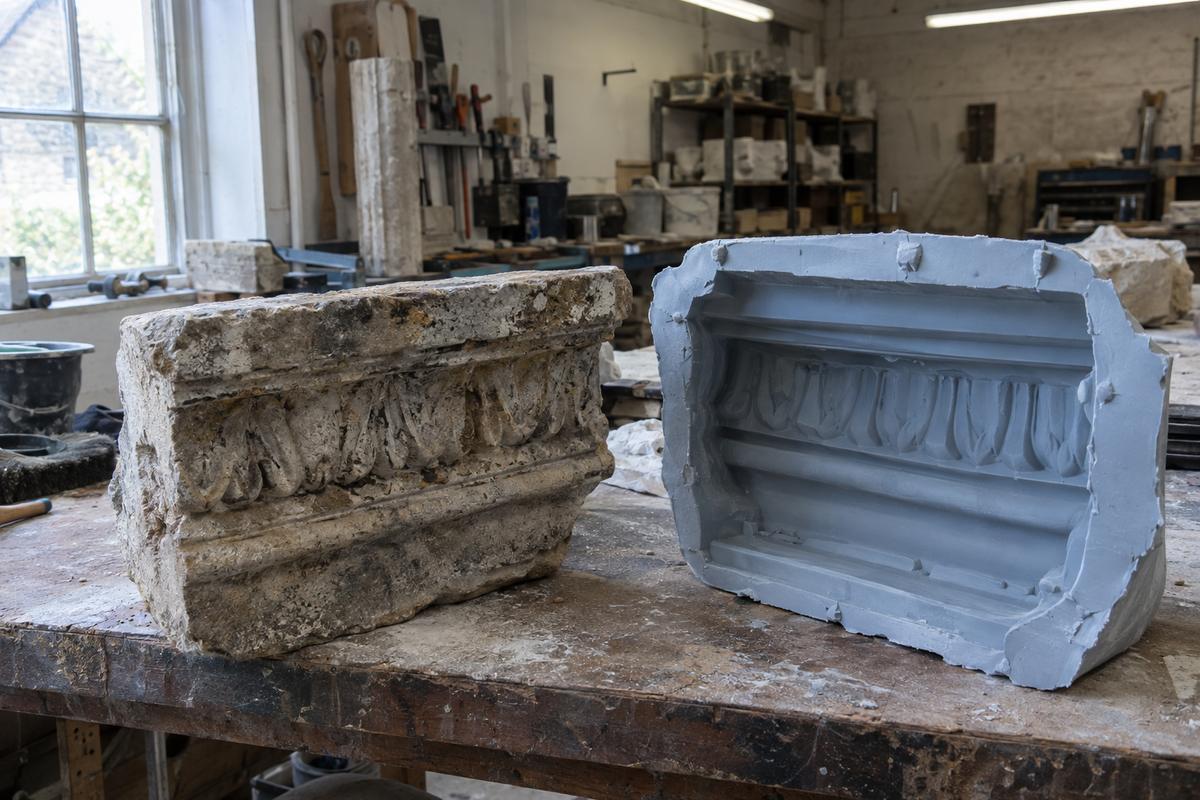
A drawing of a historic cornice, however carefully measured, always loses something. The subtle asymmetries. The weathering. The chisel marks. The tiny drift in profile from one metre to the next. Reproductions made from drawings look drawn.
A silicone mould taken directly from a surviving section keeps all of that. The reproduction reads as continuous with the neighbouring originals — not as a bright new patch stitched in.
This guide walks through how the process works, whether the sample survives on the building or off it, and how to plan the job with your conservation officer.
Three scenarios
A cornice, string course or capstone still in place while its neighbours have failed. We mould from it in situ, then use the mould to reproduce the failed sections in matching material.
A finial or keystone removed for safety, or already fallen. We bring it into the workshop, mould it on the bench, and return the original alongside the reproductions.
The feature is entirely gone, but historic photographs, drawings or a matching neighbour building exist. We build a pattern from those sources, then mould from the pattern. Slightly slower, but achievable.
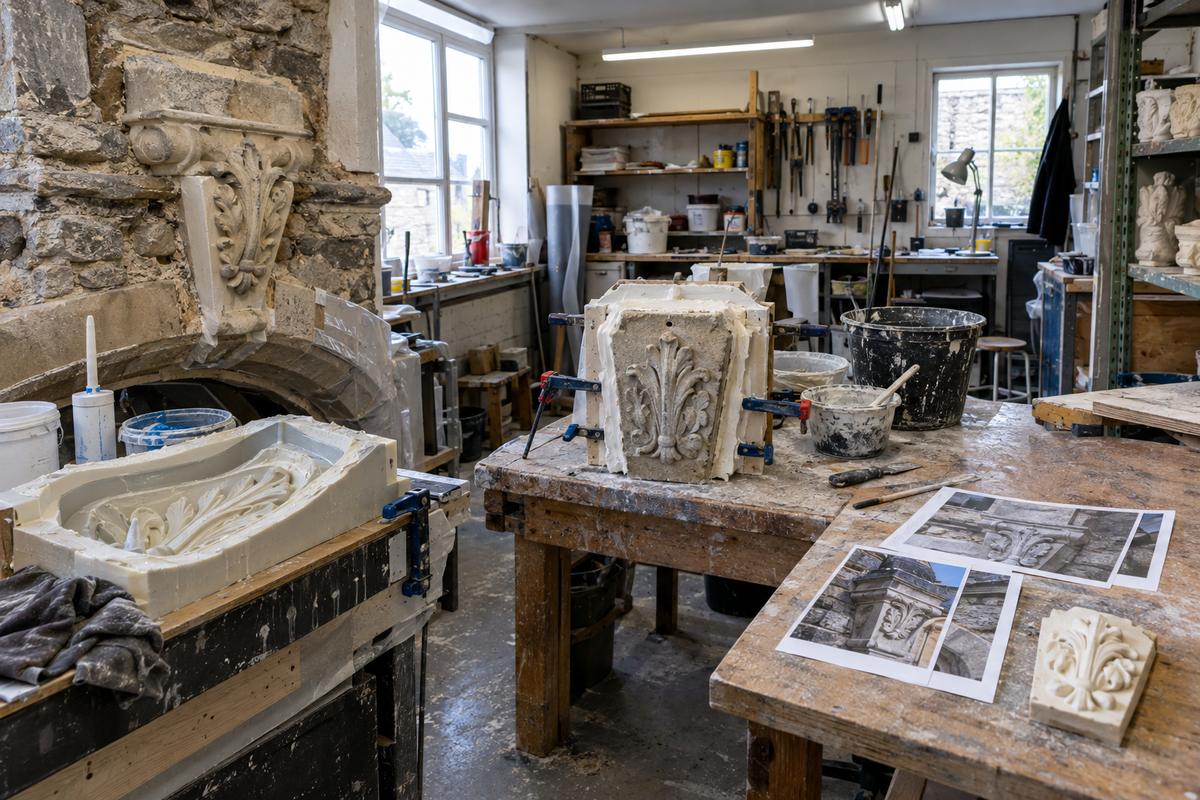
How the process runs
We come to the building or take delivery of the sample. We photograph it thoroughly, note dimensions and any conservation-officer instructions, and agree the mould methodology in writing.
If the sample has any damage that would print through into the reproductions, we discuss with the conservation team whether to repair the pattern before moulding, or capture it as-is and repair in the reproduction.
Brush-on or poured silicone, backed with a rigid mother mould. In situ jobs are done in layers so the mould can be lifted off cleanly with no residue on the original.
One reproduction cast in the specified material, brought to site alongside the original, and approved by the conservation officer before the full run is cast.
Once approved, the mould is used to cast the required number of reproductions. Each is inspected before dispatch to site.
Material choice
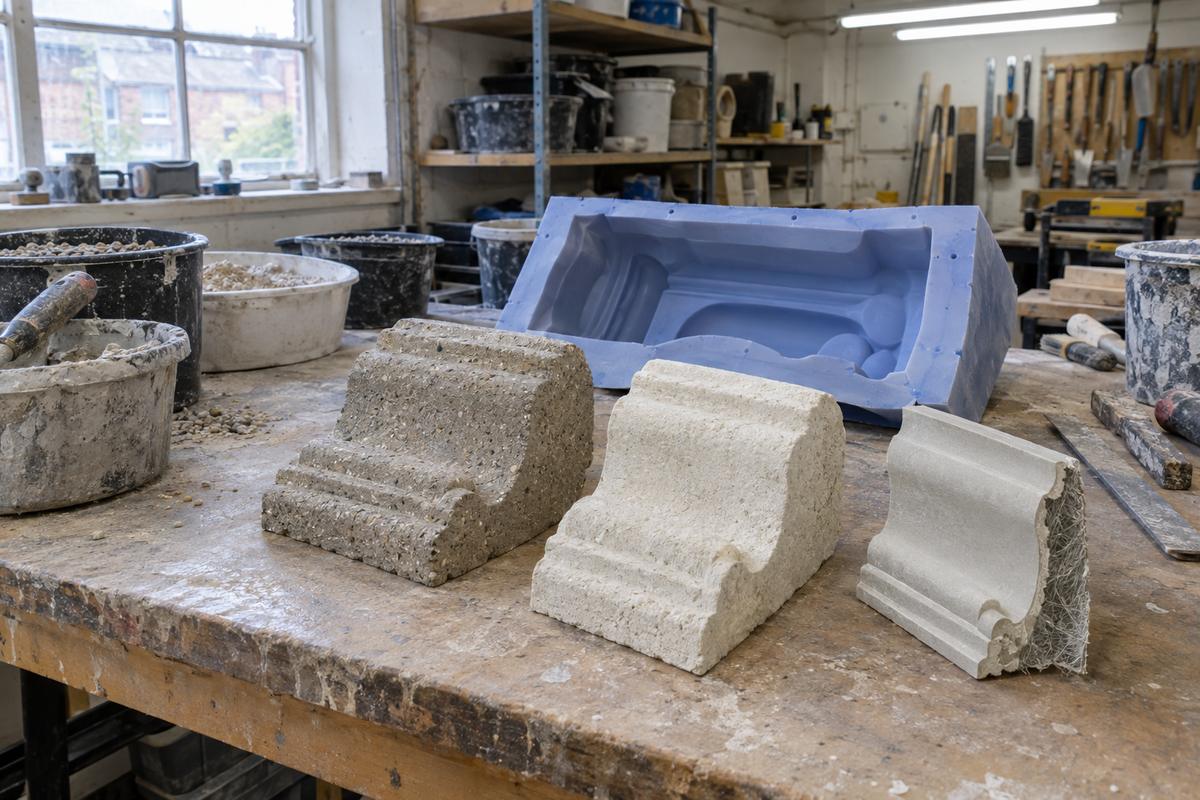
Cast stone with matched aggregate. The most common answer for Georgian and Victorian dressed-stone reproductions. Aggregate and cement blended to match the original stone's colour and grain, so the reproduction weathers alongside the originals.
Traditional lime concrete. For older or ecclesiastical work where cement-based reproductions would look wrong against limestone or lime-mortared surroundings. Slower to cast and cure but often required by the conservation team.
GRC for lightweight replacements. Where the reproduction has to sit at high level on a structure that can't take the weight of solid stone. Glass-reinforced concrete casts crisply from silicone moulds and can be pigmented to match.
The mould is the same in all cases; what you pour into it is the conversation with the conservation officer.
Working with the conservation officer
The best heritage moulding jobs have the conservation officer in the room at the first site visit. That way the methodology, the material choice, and any concerns about touching the surviving original are agreed before we spend money on tooling.
For listed buildings, this isn't optional — Listed Building Consent conditions often specify how reproductions must be made. For non-listed heritage, it's still good practice, because a conservation officer's early input can save a redesign later.
At a glance
How a two-part mould fits together
Swipe to see the whole diagram
FAQs
No, if the original is properly prepared. Silicone is chemically compatible with stone; the release regime prevents any physical adhesion. We test a small area first if the stone is friable.
Brush-on silicone applied in layers, thickened so it stays where it's put, backed with a rigid mother mould before it comes off. We've done this many times on cornices, string courses and finials still in place.
In the aggregate blend, yes to a very close visual match. Not identical to the original quarry, but close enough that the reproduction weathers alongside the originals rather than standing out.
Yes, or we can supply the mould and you cast in-house. Both routes are used regularly.
We keep it while the job is running. Once the programme is complete, ownership passes to you or, if you prefer, we hold it in our archive against future losses on the same building.
Get in touch
One photograph tells us what surface you're chasing, and one line about the mix tells us what silicone or polyurethane will survive it.
Real people, a real workshop
No call centre and no middlemen. When you contact TCI Construction, you speak to the team who design, build and check your mould.


 Thomas LaneManaging Director
 George PrestonDesign & Project Manager
 Kelly BallingerHead of Partnerships
 Jim AndertonProduction Manager
 TheodoreEmployee Welfare