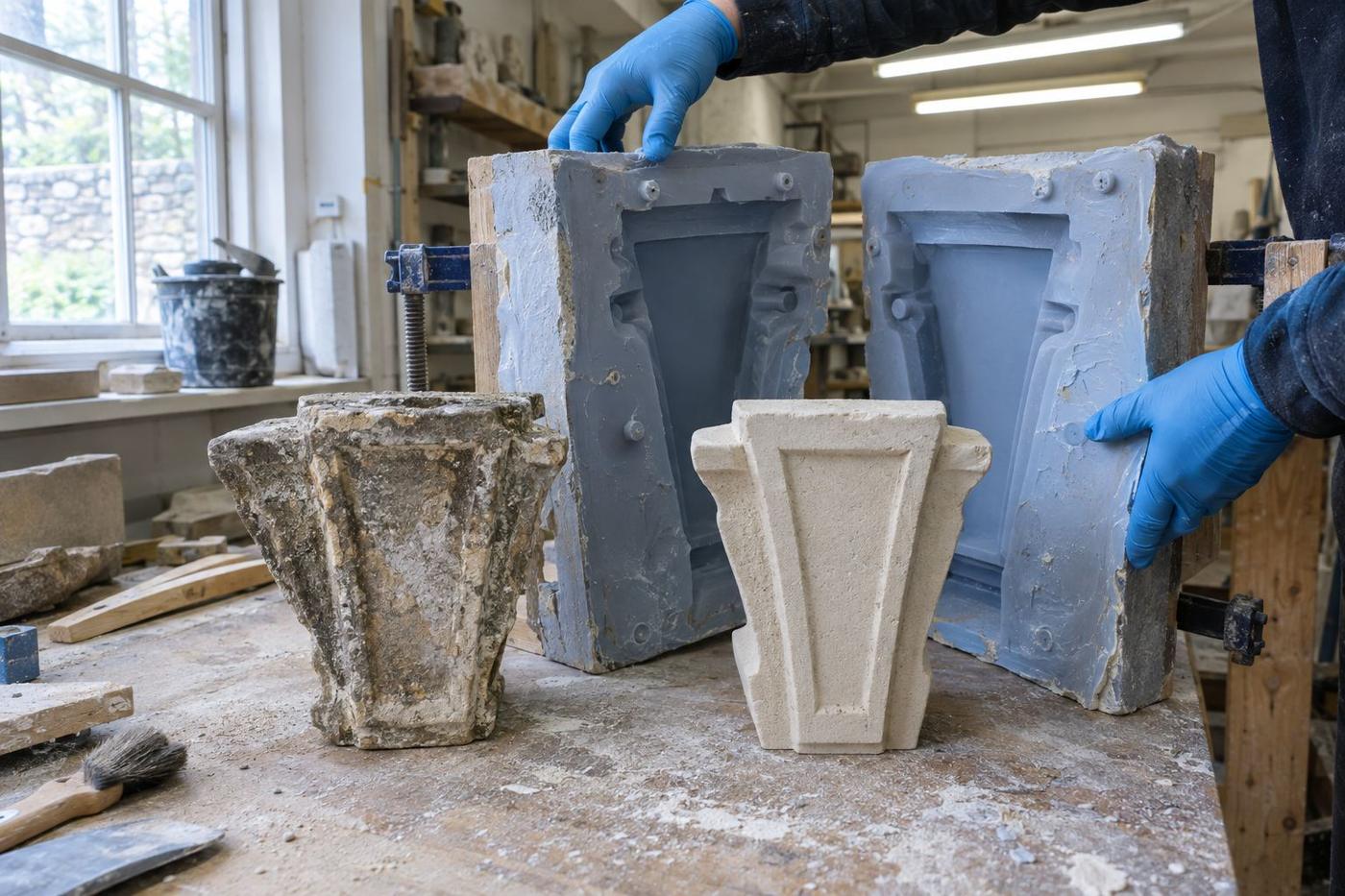
Silicone moulding on the surviving keystone
In-situ silicone moulding on the surviving twin, taking care not to disturb the original mounting. Two days on scaffold.
Project record · Cast-stone reproduction
A cast-stone workshop needed to reproduce a Georgian keystone from a surviving example on a listed doorway. Two-part silicone mould with the split placed on the return so the finished piece shows no parting mark on the visible face.
The brief
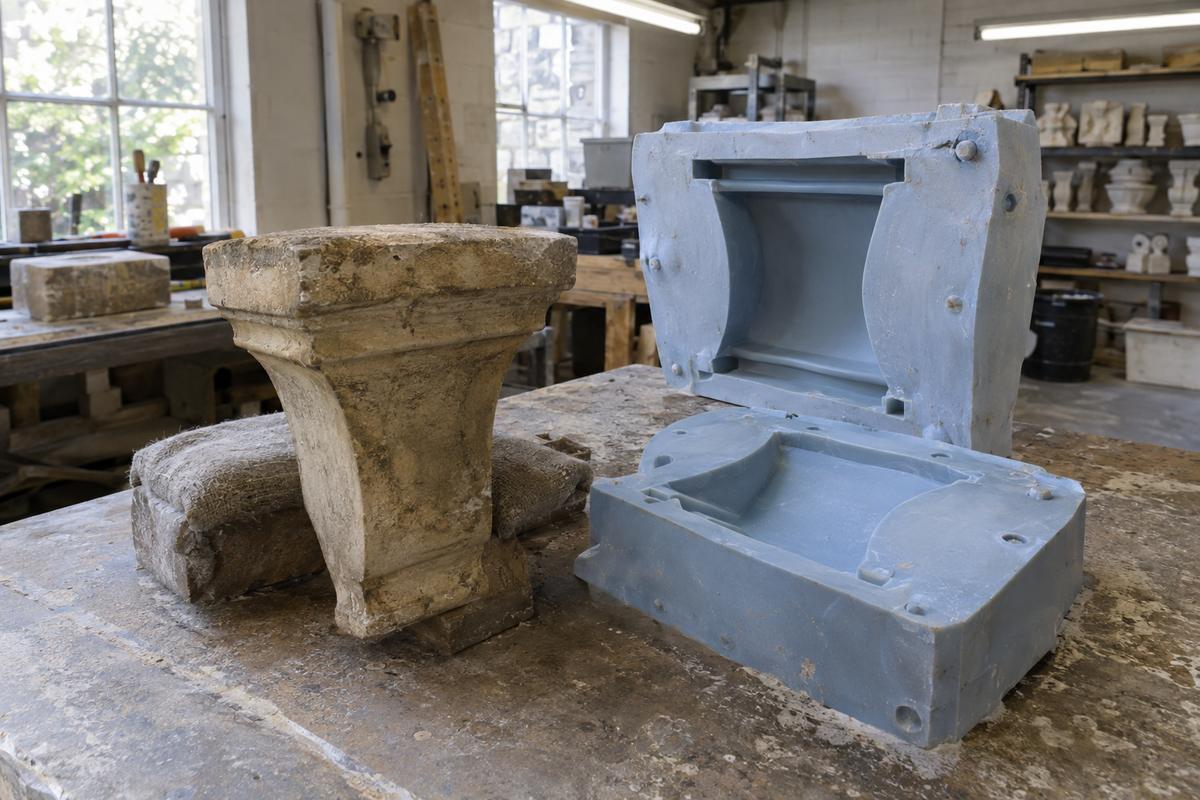
A cast-stone workshop in the West Midlands was working on a listed reinstatement where a Georgian keystone had been lost from a doorway during unauthorised alterations. The doorway's twin on an adjacent elevation still carried its original keystone. The workshop wanted to reproduce the lost keystone from the survivor and needed a mould that would run the reproduction cleanly with a visible face free of any parting mark.
The problem
The keystone had detail on the front face, both returns and the underside. A one-piece mould couldn't work — the geometry has classic undercuts on the returns. A two-part mould was inevitable.
The question was where to put the split. The workshop and the conservation officer both wanted the finished keystone to show no parting mark on any face visible from ground level. That meant the split had to fall on the top face — which sits into the arch above and is invisible in place.
How we solved it
In-situ silicone moulding on the surviving twin, taking care not to disturb the original mounting. Two days on scaffold.
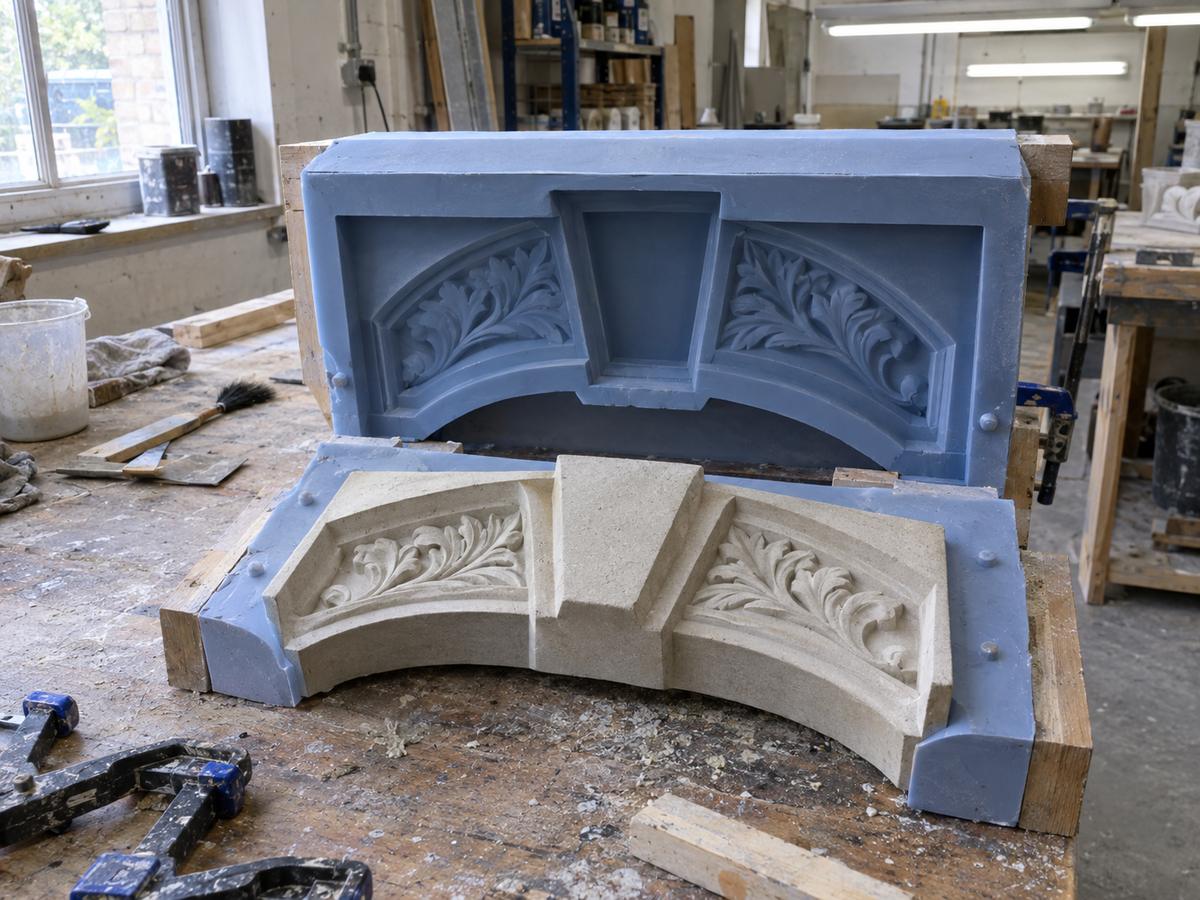
Split line placed on the top face where the keystone sits into the arch. Front, both returns and underside all captured as continuous surfaces.
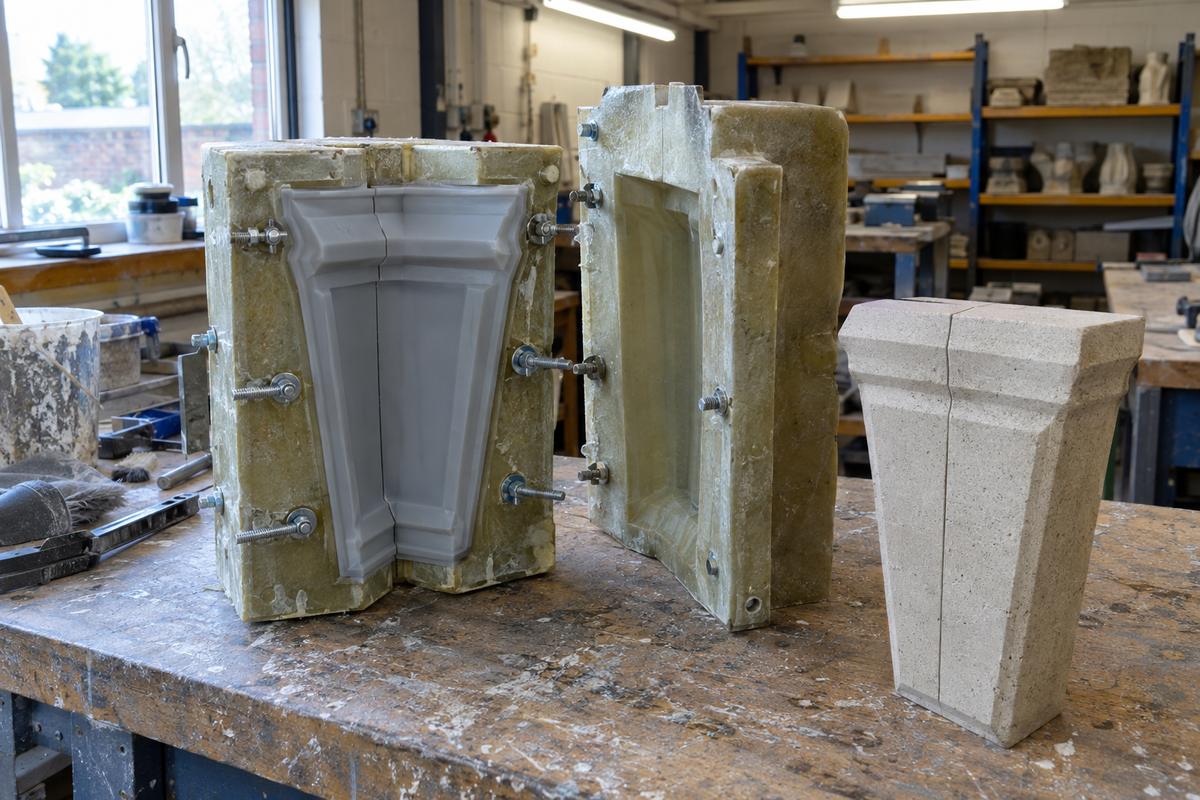
Rigid GRP backing frame in two matched halves, holding the silicone in registration through the pour and demould.
One reproduction cast in the workshop's cast-stone blend, brought to site alongside the survivor and approved by the conservation officer.
Mould handed to the workshop against future losses on the same building. The drawing and material spec kept on our archive.
The outcome
The reinstated keystone was installed and signed off. The mould is with the workshop; the archive record is with us. The reproduction is indistinguishable from the survivor at ground-level viewing distance.
Lessons
Split placement is everything on cast-stone reproductions. Get the conservation team's view on where a parting mark can and cannot fall before the mould is designed. That single decision often has more impact on the finished quality than any other.
At a glance
How a two-part mould fits together
Swipe to see the whole diagram
Get in touch
One photograph tells us what surface you're chasing, and one line about the mix tells us what silicone or polyurethane will survive it.
Real people, a real workshop
No call centre and no middlemen. When you contact TCI Construction, you speak to the team who design, build and check your mould.


 Thomas LaneManaging Director
 George PrestonDesign & Project Manager
 Kelly BallingerHead of Partnerships
 Jim AndertonProduction Manager
 TheodoreEmployee Welfare